Dupe culture is fundamentally reshaping purchasing behaviour across the UK retail landscape. No longer confined to the fringes of social media or bargain bins, the active search for affordable alternatives has become a dominant force in current skincare trends. For consumers, this shift is not solely about finding the lowest price; it is about redefining what constitutes true value in a saturated market.
As beauty trends are increasingly driven by formulation comparison and accessibility, beauty brands, retailers, and product developers must recognise this shift towards affordable skincare dupes as a structural change rather than a passing phase. Understanding the commercial mechanics of dupe culture is now essential for navigating pricing strategies, protecting brand equity, and securing market share.
What are skincare dupes?
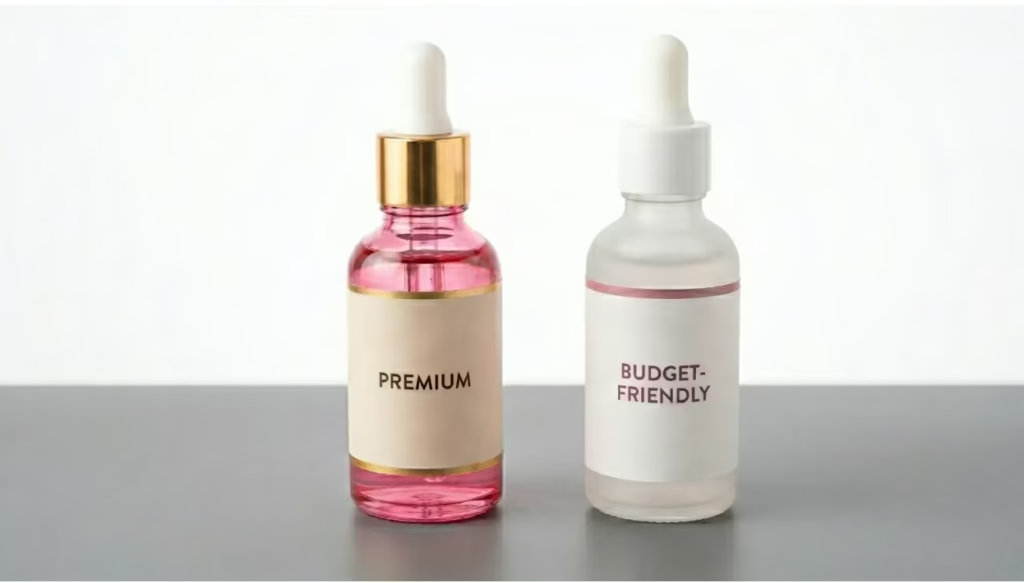
In the commercial beauty sector, a ‘dupe’ (duplicate) refers to an affordable product that mimics the formulation, texture, or aesthetic of a more expensive prestige item.
Crucially, dupes are not counterfeits. Counterfeits illegally infringe on intellectual property, trademarks, and branding to deceive the consumer. Dupes, by contrast, are legal alternatives that openly present themselves as comparable options at a fraction of the cost. Consumers actively and knowingly seek them out as smart purchasing choices.
Social media platforms have accelerated this behaviour, turning the discovery of these alternatives into a form of entertainment. Algorithms rapidly amplify viral beauty products, educating millions of users on how to achieve high-end results on a high-street budget.
Why are skincare dupes growing in popularity?
The normalisation of dupe culture is driven by a convergence of economic pressure and shifting consumer education. The key catalysts include:
- Cost-of-living pressures: Tighter household budgets have forced even prestige buyers to audit their cosmetic spending and trade down where possible.
- Ingredient transparency: The “skintellectual” consumer can now easily read and compare INCI lists, demystifying formulations that were once protected by marketing jargon.
- Comparison culture: Platforms like TikTok reward content that directly pits affordable products against luxury equivalents, providing visual proof of performance.
- Dissatisfaction with premium pricing: Successive price increases by luxury brands have pushed consumers to question whether prestige price tags reflect genuine efficacy or merely packaging and heritage.
- Rising confidence in mass market: Consumers increasingly trust that affordable brands can deliver safe, active, and highly effective results, validating broader skincare trends and beauty trends that prioritise function over brand name.
What makes a skincare dupe feel convincing to consumers?
For a dupe to successfully capture market share, it must offer more than just a low price. Consumers evaluate alternatives against strict criteria before switching. A good-quality, affordable skincare dupe typically features:
- Ingredient similarity: Prominent use of the same hero active ingredients, such as niacinamide, retinol, or hyaluronic acid, clearly displayed on the packaging.
- Familiar aesthetic cues: Packaging that heavily borrows colour palettes, typography styles, or bottle shapes from the prestige product, signalling its intended comparison to the consumer.
- Matched performance expectations: Textures and immediate skin finishes that closely replicate the sensory experience of the original.
- Visible functional claims: Clear, results-oriented copy (e.g., “hydrating”, “brightening”, “barrier repair”) that aligns with what consumers seek in trending beauty products.
- Robust social proof: Peer validation via online reviews, before-and-after photos, and user-generated content validating new beauty products as credible alternatives.
How dupe culture is affecting the beauty products industry
The proliferation of dupes is creating tangible friction across the beauty products industry. Brands can no longer rely on heritage or prestige alone to guarantee sales.
This environment is leading to significantly weaker brand loyalty; consumers are now loyal to ingredients and results rather than a specific brand name. Consideration cycles have shortened, with shoppers making rapid purchasing decisions based on algorithmic recommendations and direct price comparisons on their smartphones while in-store.
Consequently, there is immense pressure on premium brands to vigorously justify their value proposition. If a £60 serum cannot demonstrably outperform a £10 alternative, it will struggle to retain its customer base. Ultimately, this creates a fiercely competitive environment within the cosmetic industry, where the battle for consumer attention is won by those who can clearly articulate their price-to-performance ratio.
What this means for British cosmetic brands
For businesses operating in the UK, understanding the local context is vital. The UK high street has a strong tradition of high-quality, own-label retailer offerings and aggressive challenger brands that move quickly to capture market share.
British cosmetic brands cannot simply engage in a race to the bottom on price; competing purely on margins with mass-scale conglomerates is rarely sustainable. Instead, heritage English cosmetic brands and modern UK-based innovators must leverage their unique market positioning.
To compete effectively, domestic brands need absolute clarity in their messaging and product claims. They must lean into local consumer trust, sustainable manufacturing transparency, and niche formulations that are inherently harder to replicate. The UK consumer is discerning; they will pay a premium, but only when the domestic brand clearly communicates why the product cannot be easily substituted.
What beauty brands can do in response
Brands looking to insulate themselves against the threat of dupes, or capitalise on the latest beauty trends, need a proactive commercial strategy.
- Sharpen ingredient storytelling: Move beyond simply listing actives. Explain the quality of the raw materials, the specific delivery systems, and the clinical backing of the formulation.
- Make value clear without overclaiming: Ensure the price is justified by the tangible benefits, but avoid exaggerated promises that invite harsh consumer scrutiny.
- Test price perception early: Conduct rigorous research before launch to understand what price point the market will bear for your specific claims.
- Identify accurate comparison points: Know exactly which products your target audience views as your direct competitors, regardless of retail tier.
- Differentiate through experience: Focus on unique textures, signature scents (where appropriate), superior packaging functionality, and post-purchase customer service.
Monitor dupe risk: Continually assess your portfolio to identify which SKUs are most vulnerable to affordable replication.
Why market research matters in dupe-led skincare markets
In a landscape where consumer loyalty is fragile, assumptions are a liability. At AMC Insights, we understand that navigating the dupe economy requires precise, data-backed intelligence.
Market research is the only reliable tool to determine which of your products are most vulnerable to direct competition. It allows brands to decode exactly how their target demographic defines ‘value’, mapping the intersection where a price point feels credible rather than cheap or exploitative.
Through robust consumer testing, brands can identify which claims genuinely influence trust and drive purchasing intent. Crucially, bespoke research reveals the underlying motivations of your buyer—whether they are choosing a product for clinical efficacy, the prestige of the unboxing experience, or sheer convenience. Relying on concrete insight, rather than reacting blindly to viral trends, is the most effective way to protect your market position.
Reach out to AMC Insights for professional, tailored market research in the UK.
Conclusion
The normalisation of affordable skincare dupes is a clear signal of evolving consumer expectations. In today’s market, perceived value matters more than ever, and prestige brands are under continuous pressure to justify their place on the shelf.
Beauty brands that understand these behavioural shifts will adapt faster and more effectively than those that rely on outdated models of brand loyalty. In a highly competitive landscape, research-led product development and positioning will always outperform guesswork.
If you’re interested in more free knowledge on market research, check out our informative market research blog.
FAQs
1. What is the difference between a skincare dupe and a counterfeit?
A dupe is a legal, affordable alternative that mimics a premium formulation, whereas a counterfeit illegally copies a brand’s intellectual property.
2. Why are skincare dupes becoming so popular in the UK?
Their rise is driven by tighter household budgets, greater consumer understanding of active ingredients, and the normalisation of comparison culture on social media.
3. How is dupe culture impacting premium beauty brands?
It is significantly shortening purchasing cycles and eroding traditional brand loyalty, forcing prestige brands to vigorously justify their higher price points.
4. How should British cosmetic brands respond to cheaper alternatives?
Brands must focus on sharp ingredient storytelling, clear value justification, and providing unique customer experiences that mass-market dupes cannot replicate.
5. Why is market research important in a dupe-heavy skincare market?
It provides brands with concrete data on which products are vulnerable, how their specific target audience defines value, and what price points feel credible.