1. The Market Claim
The Paradigm Shift
The rapid expansion of specialty coffee in saudi arabia has elevated the sector from a standard F&B commodity into a multi-billion-dollar experiential retail asset and a foundational pillar of public social infrastructure. Driven by the structural goals of Vision 2030 to diversify the economy and expand social spaces, premium cafés have successfully positioned themselves as the modern community hubs of the Kingdom.
The Analytical Tension
However, beneath this macroeconomic success lies a complex operational reality. While commercial data highlights unprecedented growth trends, these metrics frequently mask a critical commercial challenge for operators: hyper-fluid consumer loyalty. The local market is expanding rapidly, but brand retention is increasingly difficult to sustain.
Strategic Objective
For enterprise stakeholders evaluating the specialty coffee saudi arabia landscape, long-term market viability requires looking beyond basic top-of-funnel volume metrics. Succeeding in this highly competitive ecosystem demands a nuanced understanding of a consumer base whose daily habits are governed by digital status, cultural evolution, and local delivery infrastructure.
2. The Evidence Layer
To contextualize the scale of this opportunity, market entrants must evaluate the hard data defining the current landscape. According to the saudi arabia specialty coffee market size 2024 report baseline, the specialty segment alone stands at a $2.91 billion valuation. Driven by high youth disposable income and a rapid cultural pivot, the saudi arabia specialty coffee market growth 2024 report trends project this segment to reach an impressive $6.97 billion valuation by 2033, expanding at a 10.18% CAGR.
Key Market Matrix: KSA Coffee Sector Trajectory
| Market Segment | Base Valuation | Projected Valuation | CAGR | Primary Source |
| Total Coffee Market | $4.35B (2024) | $7.19B (2032) | 6.48% | Credence Research |
| Specialty Coffee | $2.91B (2024) | $6.97B (2033) | 10.18% | Deep Market Insights |
| Ready-to-Drink (RTD) | $349.5M (2025) | $535.2M (2034) | 4.85% | IMARC Group |
| Raw Green Beans | $0.78B (2025) | $1.05B (2034) | 3.40% | The Report Cubes |
Physical Footprint & Local Hegemony
The density of physical specialty coffee shops saudi arabia boasts is unmatched in the region, currently accounting for 40% to 46% of the entire Middle East’s branded coffee shop footprint with over 5,130 active outlets. Furthermore, the saudi arabia specialty coffee shops number 2027 prediction projects this footprint to surpass 5,350 locations within the next few years.
Crucially, homegrown Saudi brands are outcompeting global Western franchises. Local players like Barn’s (800+ locations), Half Million (which has successfully expanded into London), and Kyan Café (expanding into Iraq) are weaponizing substantial domestic capital to secure premium real estate and undercut international competitors on price. This domestic dominance has been further accelerated by geopolitical tailwinds and regional boycotts, which have permanently redirected consumer loyalties toward national brands fueled by Vision 2030 pride.
Upstream Dynamics
Simultaneously, the Public Investment Fund (PIF) is actively working to insulate the domestic market from global price shocks—such as the 18% commodity price surge seen in late 2024. Through a SAR 1.2 billion ($320M) injection into the Saudi Coffee Company (SCC), the state is localizing the supply chain by revitalizing agricultural production in Jazan, Asir, and Al-Baha. The SCC aims to scale domestic production to 2,500 tonnes annually by 2028, fundamentally transforming how corporate entities engage with wholesale specialty coffee and domestic B2B networks.
3. The Research Lens (AMC’s Analysis)
In our proprietary behavioral tracking conducted across KSA, the relationship between consumer and brand reveals extreme fluidity. Standard quantitative tracking consistently misses the underlying cultural drivers behind local purchasing decisions.
The Aesthetic Premium
While high-volume sales data for single-origin roasts suggests a deeply discerning palate, specialized qualitative fieldwork reveals an entirely different behavioral engine. As over 60% of the Saudi population is under the age of 30, cafés now function as 24-hour social hubs.
Consequently, a critical demographic segment selects a specific coffee specialty saudi hub primarily as a visual asset for digital lifestyle curation on platforms like Snapchat and Instagram. The purchase is often driven by the aesthetic architecture of the venue and the social prestige of the packaging, rather than an empirical evaluation of the taste.
Frictionless App-Switching
This emphasis on digital lifestyle curation pairs with a highly optimized digital commerce environment. With an internet penetration rate of 95.72%, consumer interactions with premium specialty coffee saudi brands are heavily mediated by local delivery app duopolies like HungerStation and Mrsool, alongside dedicated platforms like COFE App.
Because these platforms make browsing, ordering, and switching between brands completely frictionless, traditional barriers to consumer defection are non-existent. The resulting environment is one of perpetual customer churn, where brand loyalty can shift entirely based on app visibility, flash promotions, or trending social media aesthetics.
4. The Commercial Implication
The Retention Trap
Entering or scaling operations within the Kingdom using standard Western customer-lifetime-value (CLV) models introduces significant forecasting errors. When consumer loyalty is fluid and mediated by third-party logistics platforms, relying on historic purchase frequencies to predict future revenue will result in misallocated capital.
Strategies for Investors
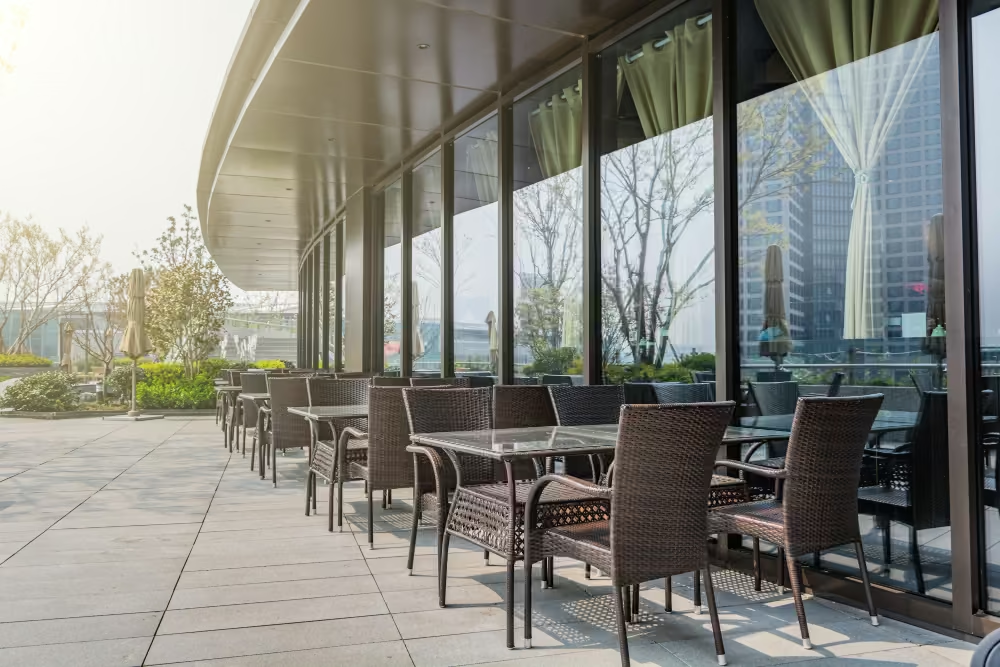
- Architectural & Narrative Differentiation: Enterprise brands must treat their physical brick-and-mortar retail space as premium social infrastructure. Interior design, packaging, and brand storytelling must be intentionally optimized to capture the digital aesthetic economy, giving the consumer a compelling reason to visit and share the experience online.
- Supply Chain Resilience: To maintain margin stability amid global market shifts, enterprise roasters and B2B operators must build direct strategic relationships with domestic wholesale specialty unroasted coffee beans suppliers and state-backed entities like the Saudi Coffee Company.
- Platform Agility: Marketing execution cannot rely purely on destination foot traffic. Brands must prioritize dynamic visibility, algorithmic optimization, and targeted promotions within local delivery duopolies to capture the high volume of consumers making immediate, app-mediated purchasing decisions.
5. Methodological Note
The Failure of Static Metrics
Relying on standard, annualized tracking metrics or traditional Western KPIs—such as basic Net Promoter Scores (NPS)—fails to capture the true drivers of the Saudi youth demographic. These static frameworks are poorly equipped to measure a market segment where purchasing motivation is tied to rapidly shifting digital trends and frictionless app-switching behavior.
The AMC Approach
To protect capital and secure sustainable growth in the evolving landscape of specialty coffee in saudi arabia, international brands and investment entities must abandon lagging indicators. Successfully navigating the specialty coffee saudi arabia sector demands continuous, geographically localized qualitative fieldwork. Only by matching on-the-ground consumer insights with operational data can stakeholders separate superficial digital noise from true, long-term commercial intent.
Ready to Look Beyond the Aesthetic?
At AMC Insights, we combine deep practitioner-level experience across KSA’s dominant delivery platforms with boots-on-the-ground qualitative fieldwork to uncover the real behavioral drivers behind consumer choices. We help you mitigate volatility, minimize customer churn, and build defensible brand retention strategies tailored to the modern Saudi consumer.
Partner with AMC Insights: Schedule a Strategic Market Intelligence Briefing.