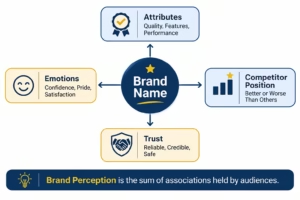
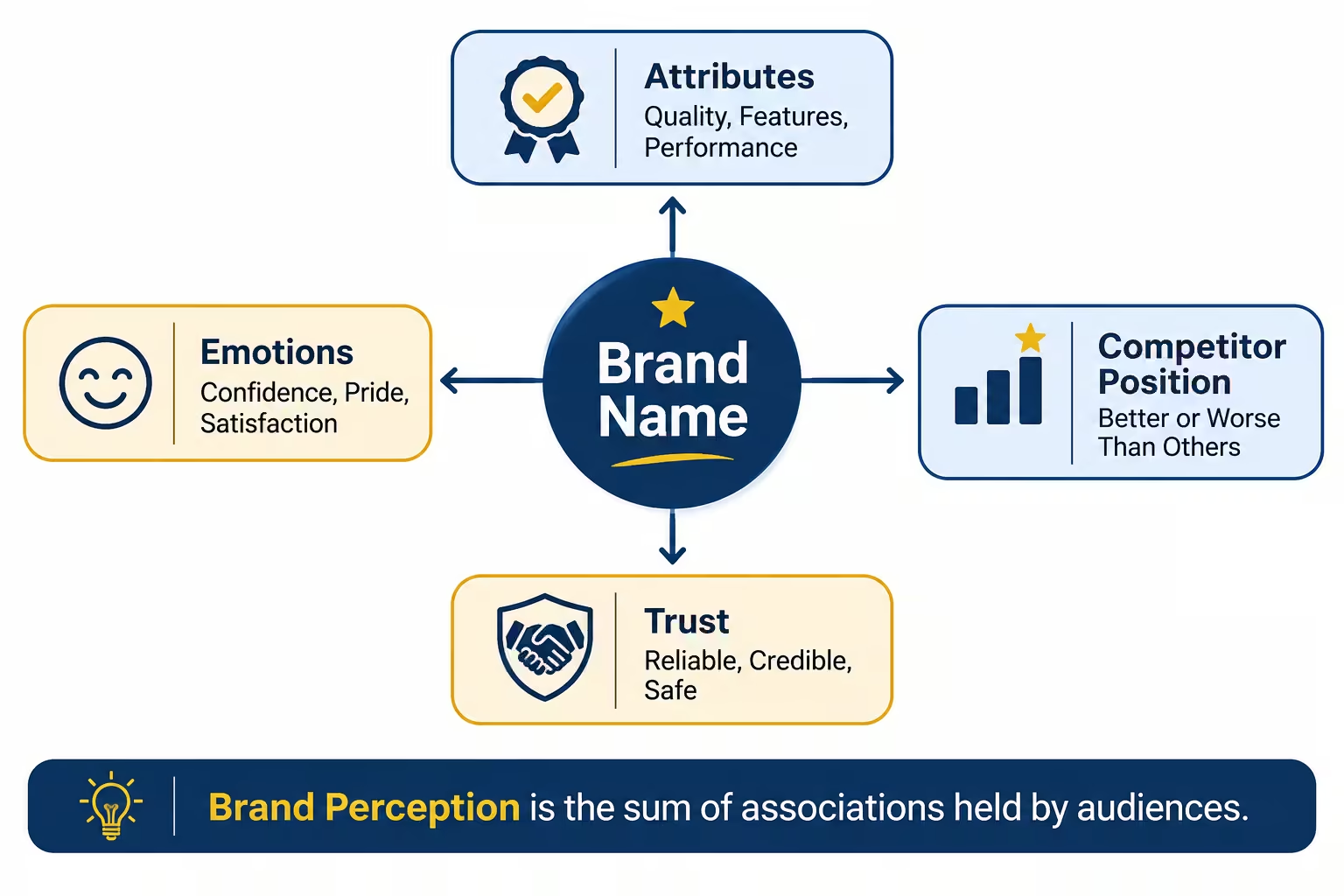
Brand perception research measures how a defined audience actually sees, describes and feels about a brand based on their experiences and associations, rather than on the brand’s intended positioning. It answers whether people trust the brand, which attributes they attach to it, and where it sits relative to competitors in their minds.
For UK marketing and brand teams, this research reduces the gap between planned messaging and real-world belief. Findings support decisions on positioning, communications, product features and service improvements.
What brand perception research actually measures
Brand perception research typically captures several distinct constructs:
- Attribute associations (what words or qualities people link to the brand)
- Favourability or overall feeling
- Trust or credibility
- Differentiation and relative preference versus named competitors
- Consideration or likelihood to choose
These sit alongside but are different from brand awareness (whether people recognise the brand exists) and from brand equity measurement (which often adds financial or loyalty dimensions). Keeping the constructs separate makes analysis clearer.
Common methods used in brand perception research
Most studies combine quantitative and qualitative approaches.
Quantitative brand perception surveys use structured questions (attribute checklists, rating scales, forced choice versus competitors) with a representative or targeted sample. They allow tracking over time and breakdowns by segment. A recurring brand tracker is the most common vehicle.
Qualitative methods (in-depth interviews or focus groups) explore why associations exist and the language people use. They are useful early on or when a quantitative result needs explanation.
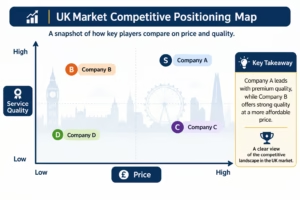
Social listening and review analysis can surface unprompted mentions between tracker waves, but they are not a full substitute for controlled sampling. Perception mapping (plotting brands on two or more attribute axes) is a common output that visualises relative position.
How to design and run a practical study
- Define the decision the research must support (for example, “Does our sustainability claim register with mid-market buyers?”).
- Specify the audience and any competitor set.
- Choose attributes that matter to buyers, not only those the brand wants to claim.
- Mix closed scales for measurement with open questions for language.
- Field the survey or qualitative sessions, then analyse by segment and against competitors.
- Translate results into clear actions (messaging changes, experience fixes, or further research).
Sample quality, question wording and competitor choice strongly affect results. Leading questions or an unrepresentative sample can produce misleading confidence.
Interpreting results and common limitations
High awareness with weak or negative attribute scores signals a perception problem, not just a media one. Scores that differ sharply by segment often point to inconsistent experiences.
Limitations include: stated perception may not match behaviour; small qualitative samples cannot be generalised; and single-wave studies cannot show change. Always state method, sample and geography when sharing findings.
How findings inform UK brand and CX decisions
Perception research helps teams decide whether to adjust positioning, strengthen a weak attribute through service or product changes, or prioritise communications. Because customer experience shapes many associations, linking perception work with customer experience research often produces clearer actions.
For organisations that need structured brand and communications insight, brand and communications research can incorporate perception measurement alongside positioning and messaging work. Broader audience context is available through consumer understanding research.
Hypothetical example: a UK retailer discovers that “reliable delivery” scores high among existing customers but low among non-buyers. The team then tests messaging and operational changes rather than increasing general awareness spend.
Practical next steps
Start with a clear business question, choose methods that match the decision, and plan how results will be acted on. Avoid treating a single survey as permanent truth.
If you are scoping brand perception research for a UK market, contact AMC Insights to discuss objectives, sample and deliverables.
Frequently Asked Questions
What is the difference between brand perception and brand image?
Brand perception is what audiences actually believe from experience. Brand image is closer to the intended or projected identity. Research measures the former.
How often should brand perception be measured?
Annual or bi-annual waves are common for stable categories; more frequent tracking suits fast-moving or high-investment brands. The right frequency depends on the rate of change in the category and the decisions being supported.
Can social listening replace a brand perception survey?
Social listening adds real-time, unprompted colour but lacks the controlled sampling and attribute consistency of a survey. Most teams use both.
What sample size is needed?
It depends on the number of segments and the precision required. A robust quantitative study usually needs several hundred completed interviews; qualitative work uses far smaller numbers for depth. Always match sample design to the decision.
Does brand perception research guarantee better sales?
No. It reduces uncertainty about current associations and highlights gaps. Commercial outcomes still depend on how effectively the organisation acts on the findings.