
Qualitative market research services explore why people think or behave as they do. Quantitative market research measures how many people hold a view or take an action. UK teams choose the method that matches the decision, not a preferred technique.
What Qualitative and Quantitative Research Answer
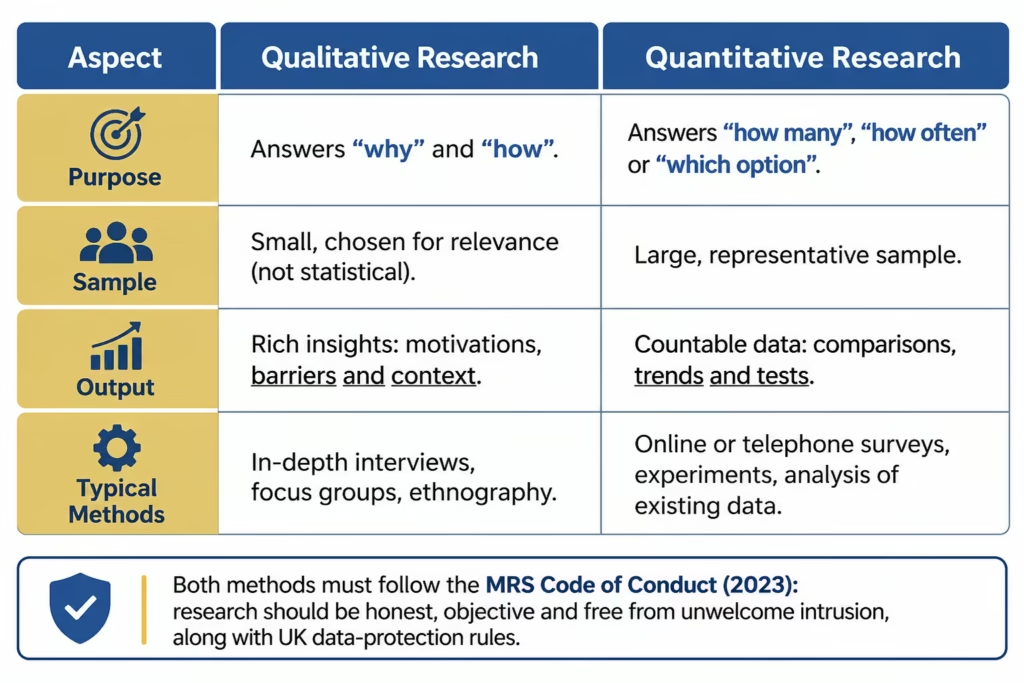
Qualitative research answers “why” and “how”. It uses open discussion, observation or diaries to surface motivations, language, barriers and context. Common methods include in-depth interviews, focus groups and ethnography. Samples are usually small and chosen for relevance rather than statistical representation.
Quantitative research answers “how many”, “how often” or “which option”. It uses structured questions with larger samples so results can be counted, compared or tested. Typical tools are online or telephone surveys, structured experiments and analysis of existing behavioural data.
The Market Research Society (MRS) Code of Conduct (2023) requires research to be honest, objective and free from unwelcome intrusion. Both methods must follow these standards and applicable UK data-protection rules.
When to Use Qualitative Market Research
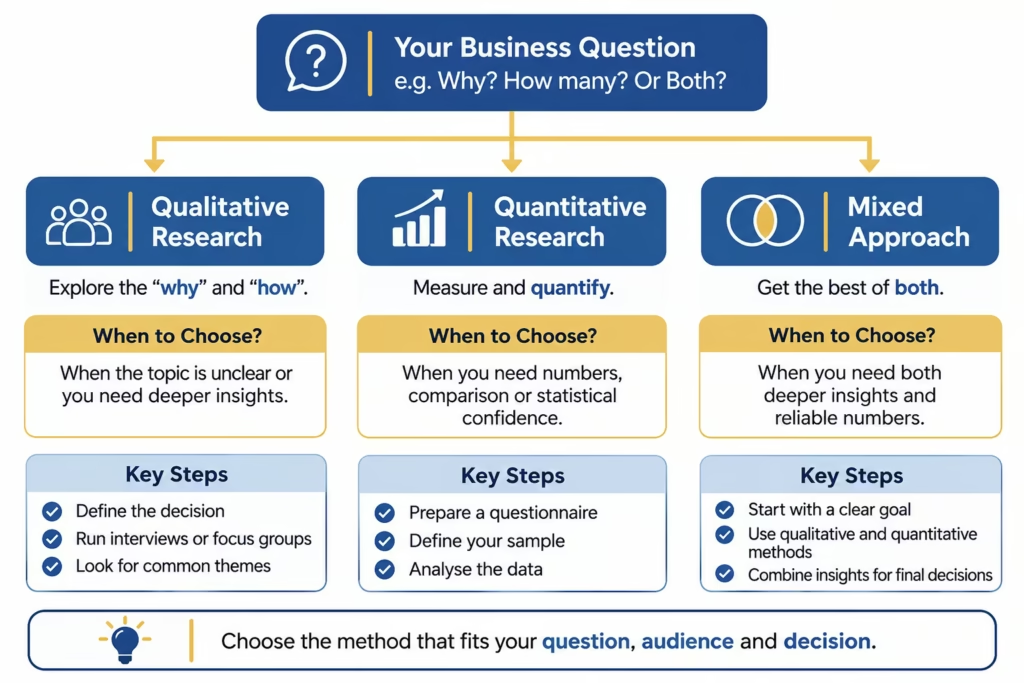
Use qualitative methods when the question is exploratory or the topic is poorly understood. Examples include uncovering reasons for low product trial, testing early concept language, or mapping the emotional side of a customer journey.
Strengths include rich context and the ability to follow unexpected lines of enquiry. Limitations include smaller samples that cannot support precise population estimates, higher cost per participant, and the risk of moderator or analyst bias. Findings should be treated as directional until tested quantitatively if scale matters.
Practical Steps for a Qualitative Study
Define the decision the research must inform. Recruit participants who match the relevant criteria. Use a discussion guide that covers key topics while leaving room for new themes. Record and analyse systematically, looking for patterns rather than counting mentions. Check that conclusions stay within what the evidence supports.
When to Use Quantitative Market Research
Use quantitative methods when you need to measure incidence, compare segments, track change over time or test a hypothesis with greater statistical confidence. Customer satisfaction scores, brand awareness levels and purchase-intent estimates are common applications.
Strengths include the ability to generalise (when the sample is properly designed) and to produce clear numeric outputs for dashboards or business cases. Limitations include the risk of poorly worded questions that force answers into artificial categories, and the inability of closed questions alone to explain unexpected results.
Practical Steps for a Quantitative Study
Write a questionnaire that matches the decision. Define the target population and sampling approach. Pre-test the instrument. Collect data, clean it, and analyse with appropriate statistics. Report margins of error or confidence intervals where relevant so decision-makers understand the precision of the estimates.
Combining Both Methods
Many robust programmes use both. Qualitative work can identify the issues worth measuring. Quantitative work can then establish how widespread those issues are. Sequential designs (qualitative then quantitative, or the reverse) are more common than simultaneous mixed-method studies for most commercial projects.
A hypothetical example: a UK retailer notices rising returns. Qualitative interviews reveal that sizing information is confusing. A follow-up quantitative survey of recent buyers measures how many customers experienced the problem and which product categories are most affected. This sequence turns a theme into an actionable priority.
Data Quality, Privacy and Limitations
Both approaches depend on clear participant information, appropriate consent or another lawful basis under UK GDPR and the Data Protection Act 2018, and secure handling of personal data. The Information Commissioner’s Office (ICO) emphasises transparency and data minimisation. Special-category data requires additional care.
Results are only as good as the design. Qualitative findings cannot be treated as percentages. Quantitative findings cannot explain “why” without further evidence. Always state sample size, method, geography and date when reporting.
Market research services from AMC Insights cover both qualitative and quantitative approaches for UK and Saudi clients. Teams can also explore market and consumer understanding work that applies these methods to brand and customer questions. For a discussion of a specific brief, contact AMC Insights.
Frequently Asked Questions
What is the main difference between qualitative and quantitative market research?
Qualitative research explores motivations and context with smaller samples. Quantitative research measures frequency and scale with larger, structured samples.
Can I use only one method?
Yes. Choose the method that answers the decision question. Use both when you need both understanding and measurement.
How large should a qualitative sample be?
There is no fixed number. Sample size depends on the research question, the diversity of the audience and the point at which new interviews stop adding meaningful insight.
Do UK data-protection rules differ for the two methods?
Both must comply with UK GDPR and the Data Protection Act 2018. Recording, special-category data and re-contact usually require clear consent or another valid lawful basis, plus transparent privacy information.