If the last few years have taught UK businesses anything, it is that “business as usual” is a concept of the past. From the sudden shock of global supply chain fractures to the rapid emergence of generative AI, the landscape is shifting under our feet. For many leaders, the traditional five-year strategic plan feels obsolete before the ink is even dry. When the future is this volatile, how do you plan for it?
The answer lies in adopting a robust scenario planning framework.
Unlike traditional forecasting, which bets the house on a single “most likely” outcome, a scenario planning framework empowers organisations to rehearse multiple futures. It transforms uncertainty from a paralyzing threat into a manageable set of variables. By exploring “what if” narratives—ranging from best-case growth to worst-case disruption—you can stress-test your strategy against reality before it happens.
In this guide, we will demystify the scenario planning process. Whether you are a FTSE 100 executive or an SME owner, you will find practical steps, real-world scenario planning examples, and a downloadable scenario planning template to help you build resilience into your business DNA.
What is Scenario Planning?
At its core, scenario planning is a strategic foresight method used to make flexible long-term plans. It allows leaders to visualize how the future environment might change and, crucially, how their business should respond.
What is scenario planning distinct from? It is often confused with forecasting, but the two are fundamentally different. Forecasting uses historical data to predict a specific future (e.g., “sales will grow 5% next year”). Scenario planning accepts that the future is unpredictable and instead presents a range of plausible alternatives (e.g., “if inflation hits 10%, we do X; if it drops to 2%, we do Y”).
It is also important to distinguish scenario planning vs business continuity. While business continuity focuses on operational recovery after a specific disaster (like a server crash or warehouse fire), strategic scenario planning looks at broader, often slower-moving shifts in the market, regulation, and consumer behaviour that could fundamentally alter your business model.
Types of Scenario Planning
Generally, there are two primary approaches:
- Exploratory Scenarios: These start in the present and project forward. They ask, “Given the drivers of change we see today (e.g., climate regulations, AI adoption), what are the possible futures?” This is the most common form of business scenario planning.
Normative Scenarios: These start with a desired future endpoint (e.g., “We want to be a Net Zero company by 2040”) and work backward to determine what steps and conditions are necessary to achieve that goal.
Core Components of a Scenario Planning Framework
To move from abstract thinking to an actionable strategy, you need a structured architecture. A successful scenario planning framework relies on seven core building blocks. At AMC Insights, we recommend following this sequence:
- Drivers of Change: The external forces (often categorised by PESTLE: Political, Economic, Social, Technological, Legal, Environmental) acting on your industry.
- Critical Uncertainties: The specific drivers that have both a high impact on your business and a high degree of uncertainty. These are the “pivot points” of your scenarios.
- The Scenario Matrix: A 2×2 grid created by crossing two critical uncertainties to generate four distinct “worlds.”
- Scenario Narratives: The detailed stories that make each quadrant of the matrix feel real. This brings the scenario plan to life for stakeholders.
- Implications: The specific risks and opportunities presented by each world.
- Options & No-Regret Moves: Strategic actions you can take. Some are specific to one scenario, while “no-regret moves” are beneficial in all of them.
- Signposts: Early warning signals (metrics or news events) that suggest a particular scenario is beginning to unfold.
Common Pitfall: A frequent mistake in the scenario planning process is creating too many scenarios. We recommend limiting your framework to 3 or 4 distinct worlds. Any more than that creates complexity that paralyzes decision-making rather than enabling it.
Step-by-Step: How to Do Scenario Planning
Ready to build your strategy? Here is how to do scenario planning in six practical steps.
Step 1: Scoping the Project
Before looking outward, look inward. Define the focal question you want to answer. Is it about the future of your supply chain over the next five years? The viability of a new product line?
- Output: A clear problem statement and defined time horizon (e.g., “The Future of UK Remote Work in 2030”).
Step 2: Identify Drivers of Change
Brainstorm the external factors that could influence your focal question. Use the PESTLE method to ensure you aren’t missing major categories.
- Tactical Example: A UK retailer might list “rising energy costs” (Economic) and “Gen Z shopping habits” (Social) as key drivers.
- Output: A long list of 10–20 trends and drivers.
Step 3: Rank Critical Uncertainties
Not all trends are created equal. Plot your drivers on an Impact/Uncertainty grid. You are looking for the two drivers that are most uncertain and have the highest impact.
- Output: The two axes for your scenario matrix (e.g., Axis X: Global Trade Openness vs. Protectionism; Axis Y: High vs. Low Tech Adoption).
Step 4: Build Scenario Narratives
Cross your two axes to create four quadrants. Give each quadrant a catchy name (e.g., “Tech Utopia” or “Digital Fragmentation”). Write a brief narrative describing what life is like in each world.
- Output: Four distinct scenario plan summaries describing the state of the market in each future.
Step 5: Derive Implications & Options
Ask your team: “If this scenario came true, what would happen to our revenue? Our staff? Our customers?” Then, identify strategies to mitigate risks or seize opportunities.
- Output: A list of strategic choices for each scenario.
Step 6: Define Signposts & Monitor
How will you know which world is arriving? Identify early indicators.
- Tactical Example: If one scenario involves a recession, a signpost might be “Consumer Confidence Index drops below 90 for two consecutive quarters.”
- Output: A monitoring dashboard of 5–10 leading indicators.
Free Excel Scenario Tracking Template You Can Use
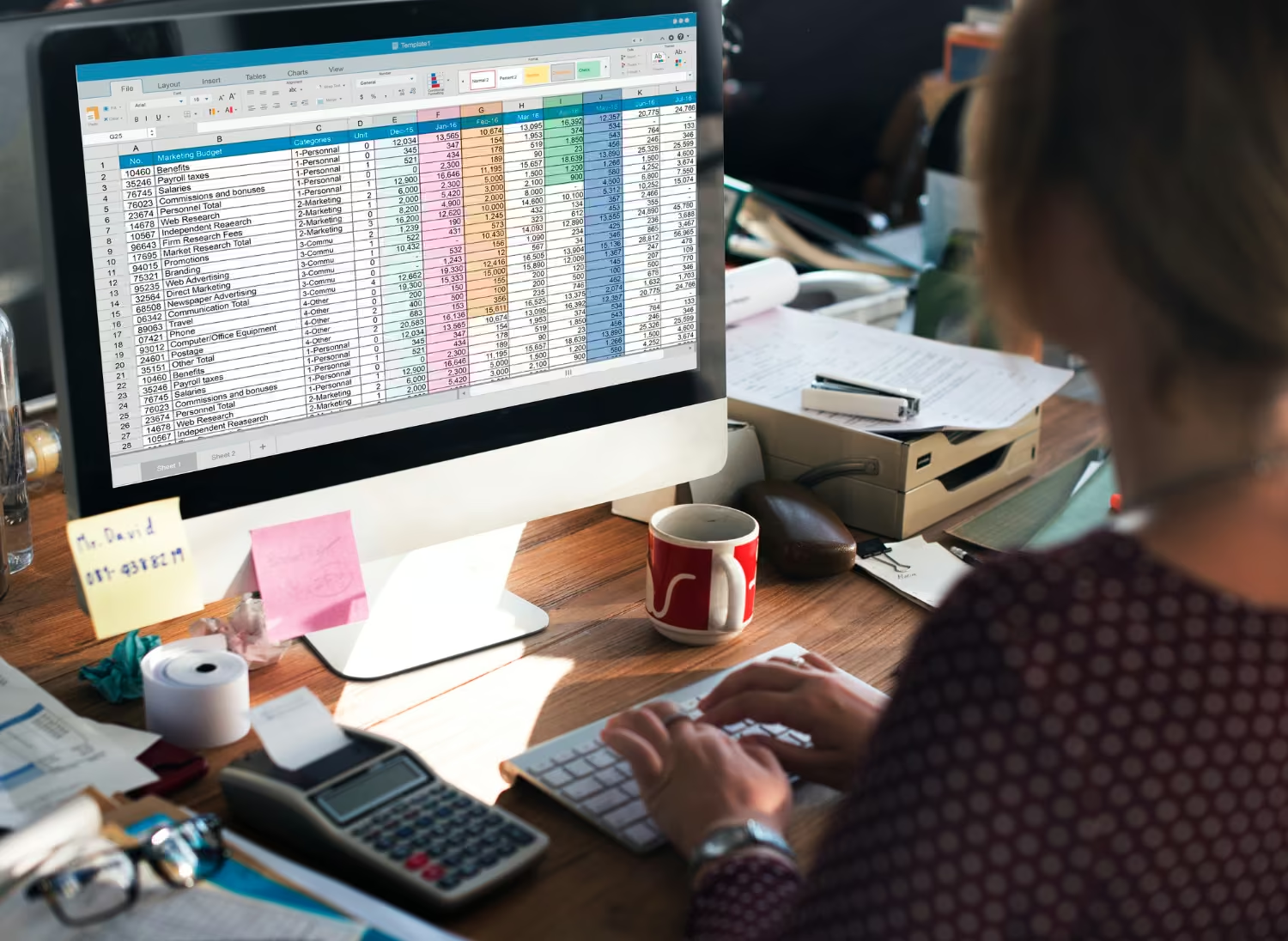
Starting from a blank page can be daunting. To help you accelerate the process, we have created a Scenario Planning Template Excel
For the analysts and strategists, this scenario planning Excel file allows for rigorous tracking. It includes pre-formatted columns for:
- Driver: The trend being tracked.
- Assumption: What we assume will happen.
- Likelihood/Impact Score: 1–5 ranking.
- Scenario Mapping: Which scenario does this driver supports?
- Early Signposts: Metrics to watch.
- Triggering Actions: What step does the business take if the signpost turns red?
Using a spreadsheet ensures that your strategic scenario planning remains a living document, not just a one-off workshop artifact.
Realistic Scenario Planning Examples
To see how this works in practice, let’s look at three anonymized scenario planning examples from different sectors.
1. Retail: The Omnichannel Shock
- Context: A UK high-street fashion brand worried about footfall.
- The Scenarios: They explored “The High Street Renaissance” (consumers crave physical experiences) vs. “The Virtual Mall” (AR/VR shopping dominates).
- Strategic Implication: In the “Virtual Mall” scenario, they realised their physical leases were a liability.
- Action: They negotiated shorter lease terms (a flexible move) and invested in 3D clothing rendering (a “no-regret” move useful in both scenarios).
2. Manufacturing: Supply Chain Disruption
- Context: An automotive parts manufacturer facing raw material volatility.
- The Scenarios: “Global Harmony” (free trade flows) vs. “Fortress Nations” (high tariffs and borders).
- Strategic Implication: Under “Fortress Nations,” their single-source supplier in Asia was a critical failure point.
- Action: They initiated a “China +1” strategy, diversifying suppliers to Turkey and Mexico. This is a classic example of business scenario planning mitigating risk.
3. SaaS: Subscription Downturn
- Context: A B2B software company serving small businesses.
- The Scenarios: “Tech Boom” vs. “Stagflation Struggle.”
- Strategic Implication: In a recession (Stagflation), their SMB customers would cancel expensive subscriptions first.
- Action: They developed a “lite” version of their software at a lower price point, ready to launch immediately if churn rates hit a specific percentage.
Tools & Software to Scale Scenario Planning
While a scenario planning template Excel file is excellent for getting started, larger enterprises often require more sophisticated scenario planning tools to handle complex data modelling.
Typically, these tool categories are used for easier scenario planning:
| Tool Category | Best For | Pros | Cons |
| Spreadsheets (Excel/Sheets) | SMEs & Initial Workshops | Free, universally understood, flexible. | Hard to maintain version control; prone to formula errors. |
| Visual Collaboration (Miro/Mural) | Brainstorming & Mapping | Excellent for remote teams to build the “Matrix” visually. | Not data-driven; doesn’t handle financial modelling. |
| Modelling Platforms (Anaplan/Pigment) | Enterprise Finance | Connects scenarios directly to financial forecasts (P&L). | High cost; steep learning curve. |
| Dedicated Scenario Software | Strategic Foresight | specialized for tracking signposts and trend scanning. | Niche; can be overkill for simple needs. |
For most mid-sized UK agencies and businesses, a combination of a visual whiteboard for the workshop and Excel for the data tracking is the most effective approach to scenario planning software.
Strategic Scenario Planning: Turning Scenarios into Action
The greatest tragedy in strategic scenario planning is creating a brilliant binder that sits on a shelf. To ensure your framework drives value, you must link it to decision-making.
Every scenario exercise should yield three types of actions:
- No-Regret Moves: Initiatives that make sense in all scenarios (e.g., cost optimization, digital upskilling). Do these immediately.
- Options/Big Bets: Investments that pay off massively in one scenario but might be risky in others. Make small investments here to keep the option open.
- Triggers: Pre-agreed points where you commit to a Big Bet.
Governance is key. Assign an owner to your “Signposts.” At AMC Insights, we recommend a quarterly review where the strategy team looks at the monitoring dashboard. If the signposts for “Scenario B” are flashing red, the team must have the authority to trigger the pre-planned actions. This transforms your scenario plan from a static document into a dynamic navigation system.
Conclusion
Uncertainty is inevitable, but being unprepared is a choice. By adopting a scenario planning framework, you give your business the foresight to see around corners and the agility to act when the market shifts.
Don’t let the next crisis catch you off guard. Start small:
- Download our scenario planning template (Excel or PPT).
- Gather your leadership team for a half-day “Drivers of Change” workshop.
- Subscribe to the AMC Insights newsletter for our quarterly “Signposts” report, where we track the macro trends affecting UK markets.
Ready to build your future-ready strategy? Contact AMC Insightstoday to facilitate your first scenario planning session.