Consumer behaviour research examines why and how people notice, choose, buy and use products or services. It combines qualitative and quantitative methods to reveal motivations, barriers and decision patterns that pure sales data cannot show. UK businesses use it to refine positioning, product features, messaging and customer experience.
What Is Consumer Behaviour Research?
Consumer behaviour research studies the factors that shape purchasing and usage decisions. These include needs, attitudes, habits, social influences and context. It goes beyond demographics to explain the “why” behind choices.
Research can be primary (new data collected for the specific question) or secondary (existing reports and data). Primary work is usually required when the decision is brand- or category-specific. The Market Research Society (MRS) Code of Conduct requires transparent, ethical practice, including clear participant information and accurate reporting of sample characteristics when claims of representativeness are made.
Why It Matters for UK Businesses
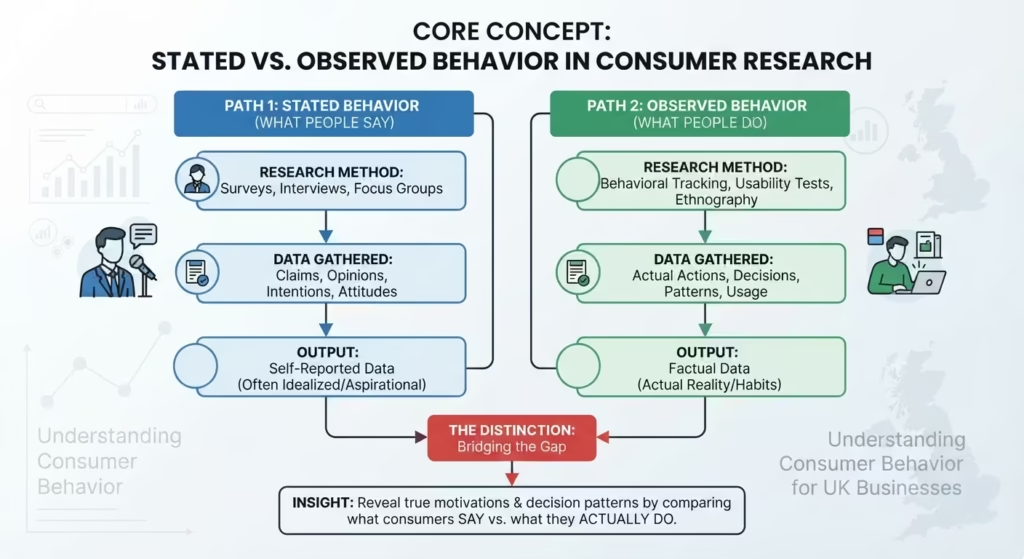
Stated preferences often differ from actual behaviour. A survey may show high interest in a feature that shoppers ignore at the shelf. Consumer behaviour research reduces this gap and supports decisions on pricing, packaging, channel and communications.
It is especially useful when launching or repositioning a product, entering a new segment, or diagnosing declining sales. Findings inform what to test next rather than guaranteeing outcomes. UK official surveys such as Food and You 2 (Food Standards Agency) demonstrate rigorous sampling from the Postcode Address File with push-to-web methods to measure self-reported knowledge, attitudes and behaviour on food-related topics.
Key Methods for Consumer Behaviour Research
Match the method to the decision. No single approach is best for every question.
Qualitative Approaches
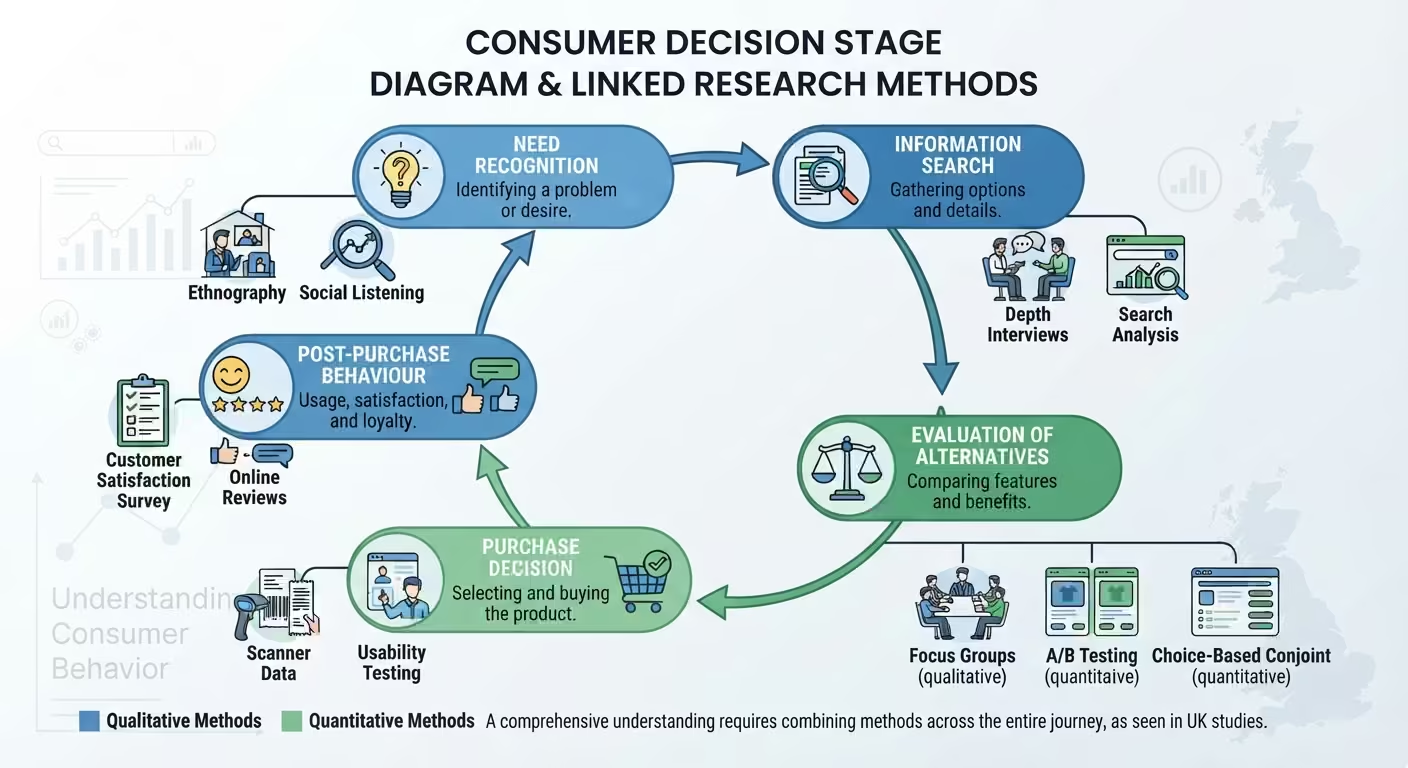
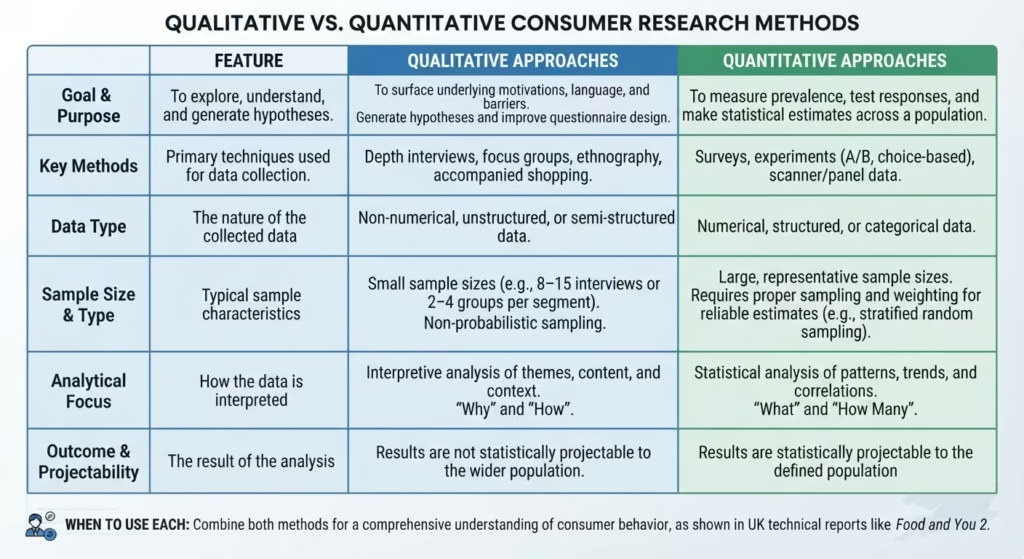
Depth interviews and focus groups surface language, motivations and barriers. Ethnography or accompanied shopping observes real behaviour in context. These methods generate hypotheses and improve questionnaire design. Sample sizes are typically small (often 8–15 interviews or 2–4 groups per segment). Results are not statistically projectable.
Quantitative Approaches
Surveys measure prevalence of attitudes or claimed behaviours across a defined population. Experiments (including A/B or choice-based) test actual responses to price, claims or design. Scanner or panel data show purchase patterns over time. Proper sampling and weighting are essential for reliable estimates. The Food and You 2 technical reports illustrate stratified random address sampling and mixed-mode collection to improve coverage.
Steps to Conduct Consumer Behaviour Research
- Define the decision and specific questions. Vague objectives produce unusable data.
- Review existing secondary sources (internal sales, public statistics, prior studies) to avoid repeating known information.
- Choose methods and design the sample. Define the target population clearly and state limitations.
- Develop instruments (discussion guides or questionnaires). Pre-test them.
- Collect data following ethical standards (informed consent, data protection under UK GDPR/Data Protection Act 2018).
- Analyse, looking for patterns, contradictions between stated and observed behaviour, and segments.
- Translate findings into implications and recommended next actions, noting confidence levels and gaps.
Market and consumer understanding services can support design and interpretation of this process.
Common Limitations and How to Address Them
Self-reported data can be biased by social desirability or poor recall. Observation and behavioural experiments help. Small qualitative samples cannot be generalised. Non-response in surveys can skew results; weighting and transparent response-rate reporting reduce risk. Context matters: behaviour in a research setting may differ from real purchase situations. Always state the method, sample, date and geography when citing findings.
How Findings Inform Decisions
Insights can prioritise product features, refine messaging, identify segment differences or highlight experience friction points. They do not replace commercial judgement or testing. A common next step is to validate key findings with a quantitative study or limited market test before full investment.
Broader market research services cover complementary methods such as sizing or competitive analysis.
Practical Takeaways
Start with a clear decision, not a method. Combine methods when resources allow. Document sampling and limitations. Use findings to shape testable actions rather than final strategy. For complex projects, specialist support ensures methodological quality and actionable reporting.
Contact AMC Insights to discuss a consumer behaviour research brief.
Frequently Asked Questions
1. What is the difference between consumer behaviour research and market research?
Consumer behaviour research focuses specifically on the drivers of individual and group choices. Market research is broader and can include sizing, competition, pricing and channel analysis.
2. How long does a typical consumer behaviour study take?
Qualitative work can be completed in 3–6 weeks. Quantitative surveys often take 4–8 weeks depending on sample size, fieldwork and analysis. Timelines vary with scope.
3. Can AI replace traditional consumer behaviour research?
AI can speed analysis of open-ended responses or large text datasets, but it does not replace careful design, sampling or human interpretation. Data quality, bias and validation still require oversight.
4. Is consumer behaviour research suitable for small businesses?
Yes, when focused. A small number of well-designed interviews or a targeted survey can surface useful insights if the questions are specific and limitations are accepted.