
Customer satisfaction measurement is the structured process of collecting and analysing feedback so organisations can understand how customers feel about products, services and interactions. The most widely used metrics are CSAT, NPS and CES. Used together and interpreted carefully, they give UK businesses a clearer view of experience quality, loyalty risk and operational friction.
Why Customer Satisfaction Measurement Matters
Satisfied customers are more likely to stay, buy again and recommend a brand. Poor experiences increase churn, complaint volume and acquisition cost. Measurement turns anecdotal feedback into trackable data that can be reviewed by leadership, linked to commercial outcomes and used to prioritise improvements.
In the UK, external benchmarks such as the Institute of Customer Service’s UK Customer Satisfaction Index (UKCSI) provide sector-level context. Individual organisations still need their own consistent measures so they can track change over time and diagnose specific problems.
The Three Core Metrics
Most organisations start with three complementary metrics.
Customer Satisfaction Score (CSAT)
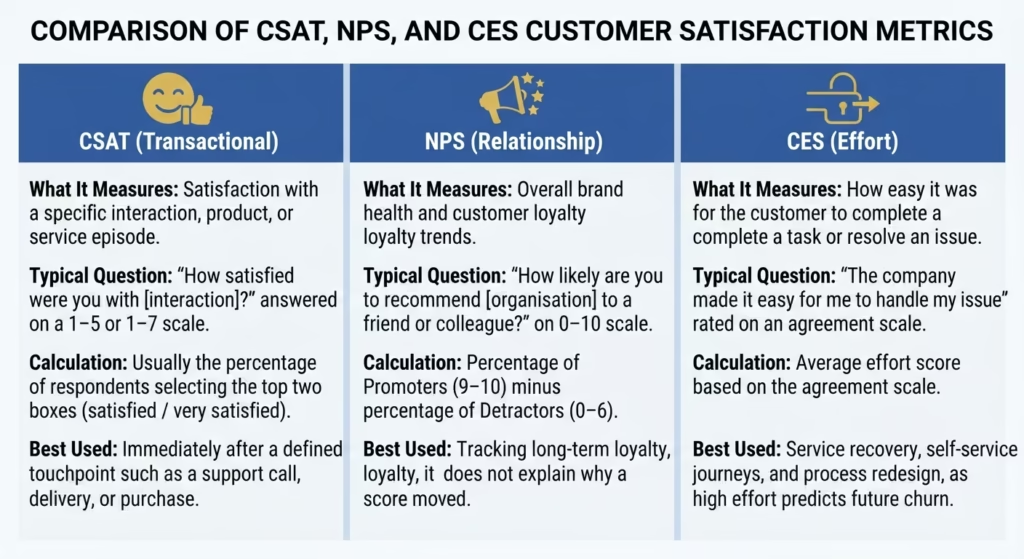
CSAT measures satisfaction with a specific interaction, product or service episode. A typical question is: “How satisfied were you with [interaction]?” answered on a 1–5 or 1–7 scale.
The score is usually calculated as the percentage of respondents who select the top two boxes (satisfied / very satisfied). CSAT is best used immediately after a defined touchpoint such as a support call, delivery or purchase.
Net Promoter Score (NPS)
NPS asks: “How likely are you to recommend [organisation] to a friend or colleague?” on a 0–10 scale. Respondents are grouped as promoters (9–10), passives (7–8) and detractors (0–6). The score is the percentage of promoters minus the percentage of detractors.
NPS is a relationship-level metric. It is useful for tracking overall brand health and loyalty trends, but it does not explain why a score moved.
Customer Effort Score (CES)
CES measures how easy it was for the customer to complete a task or resolve an issue. A common form is: “The company made it easy for me to handle my issue” rated on an agreement scale.
High effort is a strong predictor of future churn. CES is particularly useful for service recovery, self-service journeys and process redesign.
Choosing and Combining Metrics
No single metric is sufficient. A practical approach is:
- Use CSAT for day-to-day operational feedback after key interactions.
- Use NPS for periodic relationship health checks (for example quarterly).
- Use CES when diagnosing friction in processes or digital journeys.
Many UK teams also track related operational indicators such as first-contact resolution, complaint volume and retention rates. The value comes from reading the metrics together rather than treating any one number as a target in isolation.
Practical Steps for Reliable Measurement
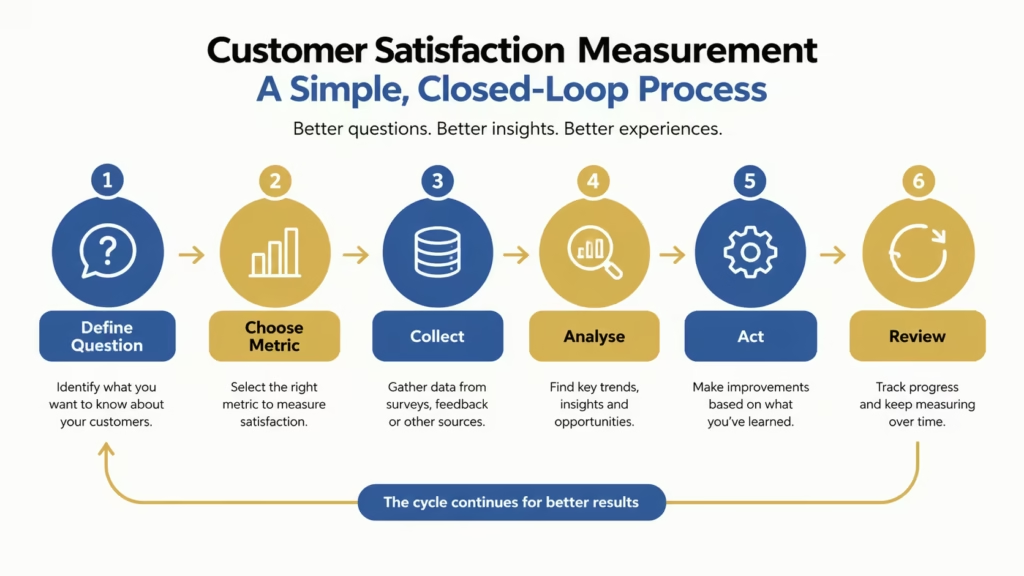
- Define the business question first. Decide whether you need transactional feedback, relationship health or process effort data.
- Choose the right moment. Send CSAT immediately after the interaction; run NPS on a regular cadence with a clear sample frame.
- Keep surveys short. One primary metric question plus an optional open comment usually yields higher response rates.
- Sample carefully. Ensure the respondents actually experienced the interaction or relationship you are measuring.
- Close the loop. Share findings with the teams who can act and, where appropriate, follow up with customers who reported problems.
- Review methodology regularly. Check response rates, sample bias and whether the questions still match the journeys that matter.
Common Pitfalls
- Treating NPS as the only number that matters and ignoring transactional insight.
- Surveying too frequently or at the wrong moment, which depresses response rates and creates fatigue.
- Focusing on the score itself rather than the drivers behind it.
- Comparing internal scores with external benchmarks without matching methodology, sample or sector.
- Collecting data without a clear plan for analysis and action.
When External Research Support Helps
Internal surveys work well for continuous operational tracking. External research becomes useful when organisations need independent benchmarking, more robust sampling, qualitative depth to explain scores, or specialised analysis that links satisfaction to commercial outcomes.
Customer Experience Services can support the design of measurement frameworks, the running of structured studies and the translation of findings into prioritised actions.
Key Takeaways
Customer satisfaction measurement works best when it is purposeful, timely and linked to action. CSAT, NPS and CES each answer different questions. Used together, reviewed regularly and supported by clear ownership, they give UK businesses a practical way to protect loyalty and improve experience.
Frequently Asked Questions
1. What is the difference between CSAT and NPS?
CSAT measures satisfaction with a specific interaction or experience. NPS measures likelihood to recommend and is treated as a relationship or loyalty metric.
2. What is a good CSAT score?
There is no universal “good” score. Many organisations treat scores above 80% (top-two-box) as strong, but the most useful benchmark is your own historical trend and, where available, sector peers measured the same way.
3. How often should we measure customer satisfaction?
Transactional CSAT can be continuous after key interactions. Relationship metrics such as NPS are commonly run quarterly or twice yearly to avoid survey fatigue while still detecting change.
4. Can we rely only on online reviews?
Reviews are useful directional signals but are self-selecting and rarely representative. Structured measurement with a defined sample gives a more reliable picture.