
Consumer behaviour research examines why people choose, use or reject products and services. It combines what customers say with what they actually do, helping UK organisations reduce risk in marketing, product and pricing decisions.
What consumer behaviour research covers
It looks at needs, motivations, barriers, decision journeys and post-purchase experience. In the UK, this often draws on official household spending data alongside primary studies. Office for National Statistics figures show household spending grew 0.3% in real terms in April to June 2026, with clothing and footwear, restaurants and hotels, and housing among the larger contributors. Such secondary signals set context; primary research then explains the “why” behind category or brand-level patterns.
The Market Research Society defines research as the collection, use or analysis of information about individuals or organisations to establish facts, acquire knowledge or reach conclusions, using social, behavioural and data science techniques. This frames consumer behaviour work as decision support rather than opinion gathering.
What consumer behaviour research covers
It looks at needs, motivations, barriers, decision journeys and post-purchase experience. In the UK, this often draws on official household spending data alongside primary studies. Office for National Statistics figures show household spending grew 0.3% in real terms in April to June 2026, with clothing and footwear, restaurants and hotels, and housing among the larger contributors. Such secondary signals set context; primary research then explains the “why” behind category or brand-level patterns.
The Market Research Society defines research as the collection, use or analysis of information about individuals or organisations to establish facts, acquire knowledge or reach conclusions, using social, behavioural and data science techniques. This frames consumer behaviour work as decision support rather than opinion gathering.
Choose the right methods
Match method to the decision. Primary and secondary research approaches each play a role.
Secondary sources such as ONS consumer trends or retail sales series provide scale and trend context at low cost. They rarely explain brand-specific drivers.
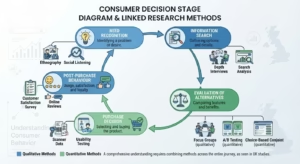
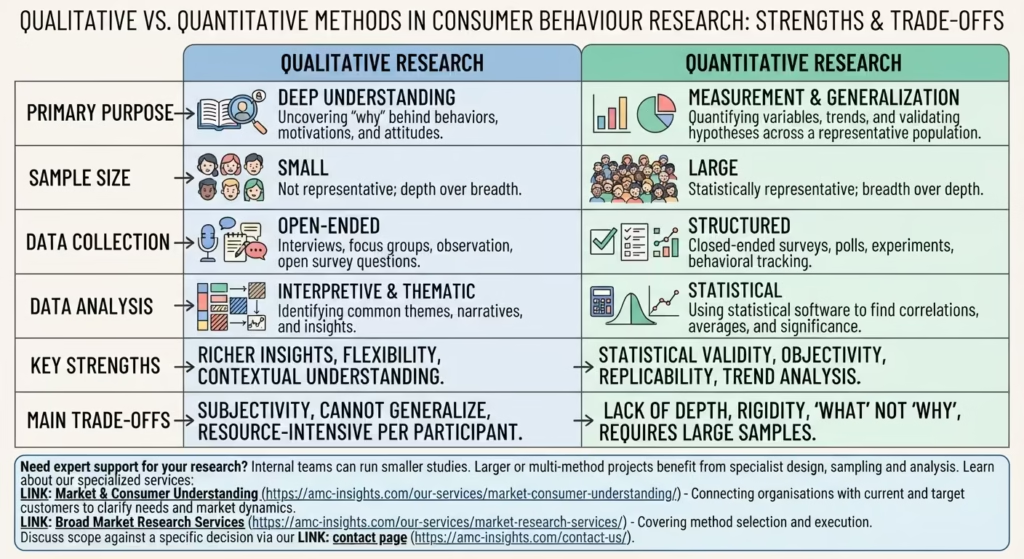
Primary methods fill that gap. Surveys quantify prevalence of attitudes or behaviours across a sample. In-depth interviews and focus groups explore motivations and language. Observation or diary studies capture actual use that people may not recall accurately. Ethnographic approaches observe people in real settings, such as a London supermarket aisle or home kitchen.
Qualitative work is strong for early exploration and message development. Quantitative work supports sizing, segmentation and tracking. Most robust programmes combine both so findings can be checked against each other. Limitations include social desirability bias in stated responses and the difficulty of recruiting hard-to-reach groups.
Practical steps for a UK project
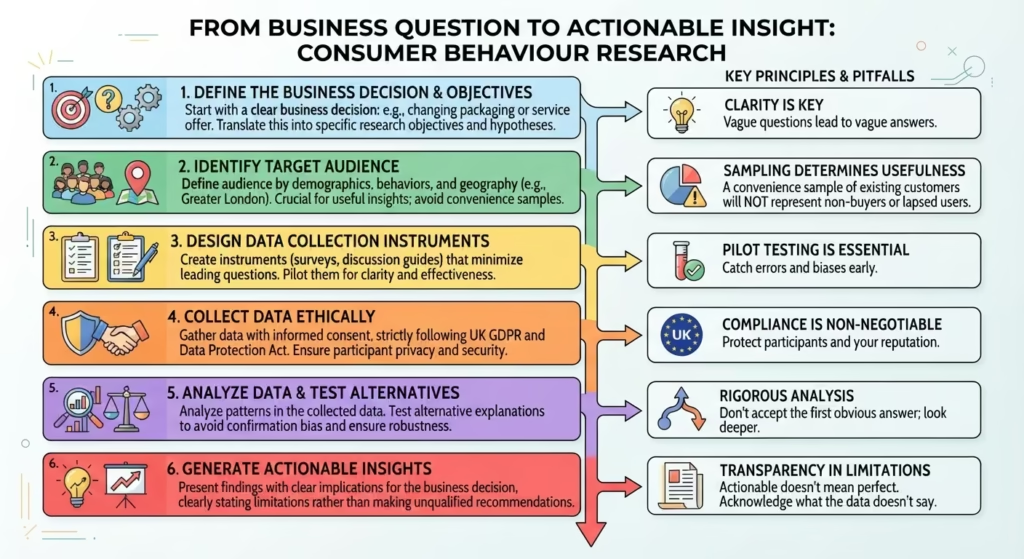
Start with a clear business decision: for example, whether to change packaging for a grocery brand or adjust a service offer in Greater London. Translate that into research objectives and hypotheses.
Define the target audience carefully—demographics, behaviours and geography. Sampling quality determines usefulness; a convenience sample of existing customers will not represent non-buyers or lapsed users.
Design instruments that minimise leading questions. Pilot them. Collect data with appropriate consent and data-protection practices under UK GDPR and the Data Protection Act. Analyse for patterns, then test alternative explanations. Present findings with clear implications and stated limitations rather than unqualified recommendations.
How findings inform decisions
Well-designed research reduces uncertainty. It can show which product attributes drive choice, where journey friction exists, or how price sensitivity varies by segment. It supports prioritisation of marketing spend or product features. It does not guarantee outcomes; markets, competitors and external factors continue to change.
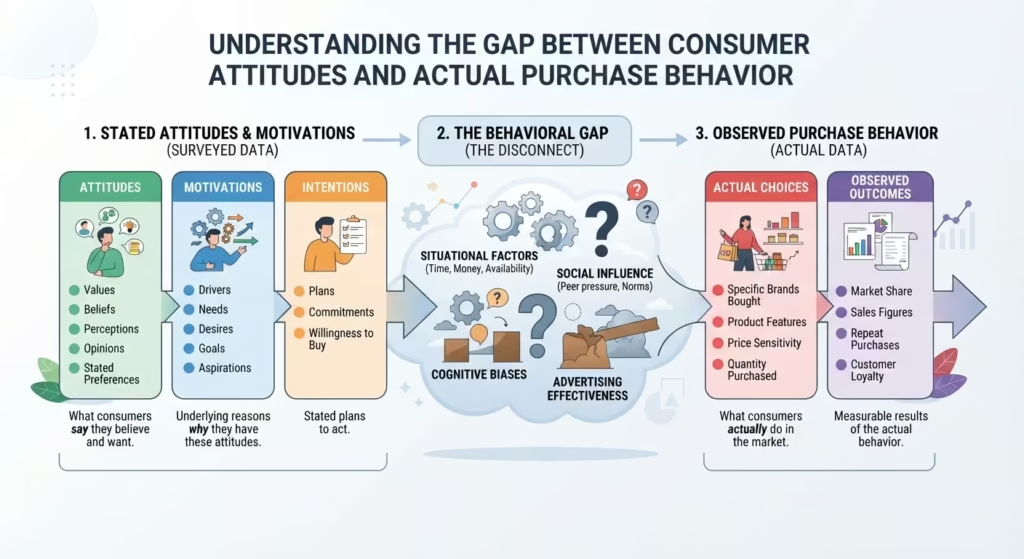
Common mistakes include treating correlation as causation, generalising from small non-representative samples, or ignoring the gap between what people say they will do and what they actually do. Transparent method notes and sensitivity checks help decision-makers weigh the evidence.
Limitations to keep in mind
Stated intentions often overstate future behaviour. Sample bias, question wording and context all affect results. Secondary data may lag or use classifications that do not match commercial categories. AI-assisted analysis of open text or behavioural data requires human oversight to check context, bias and validation against known sources. Findings are specific to the sample, timing and method used.
When external support helps
Internal teams can run smaller studies. Larger or multi-method projects benefit from specialist design, sampling and analysis. Market & Consumer Understanding services focus on connecting organisations with current and target customers to clarify needs and market dynamics. Broader market research services cover method selection and execution. Discuss scope against a specific decision via the contact page.
Frequently Asked Questions
1. What is the difference between consumer behaviour research and market research?
Consumer behaviour research is a focused area within market research that examines individual and group decision processes, motivations and actions. Market research also covers market size, competition and pricing.
2. How long does a typical project take?
Simple survey or interview studies often take several weeks. Multi-method or tracking programmes take longer. Timelines depend on sample size, method and analysis depth.
3. Can I use only secondary data?
Secondary sources such as ONS series provide useful context and scale but rarely answer brand- or product-specific “why” questions. Most commercial decisions benefit from primary research as well.
4. How do I reduce bias in responses?
Use neutral wording, multiple methods, validated scales where appropriate, and checks against observed behaviour or secondary data. Report limitations clearly.