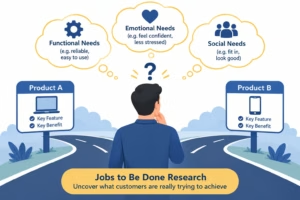
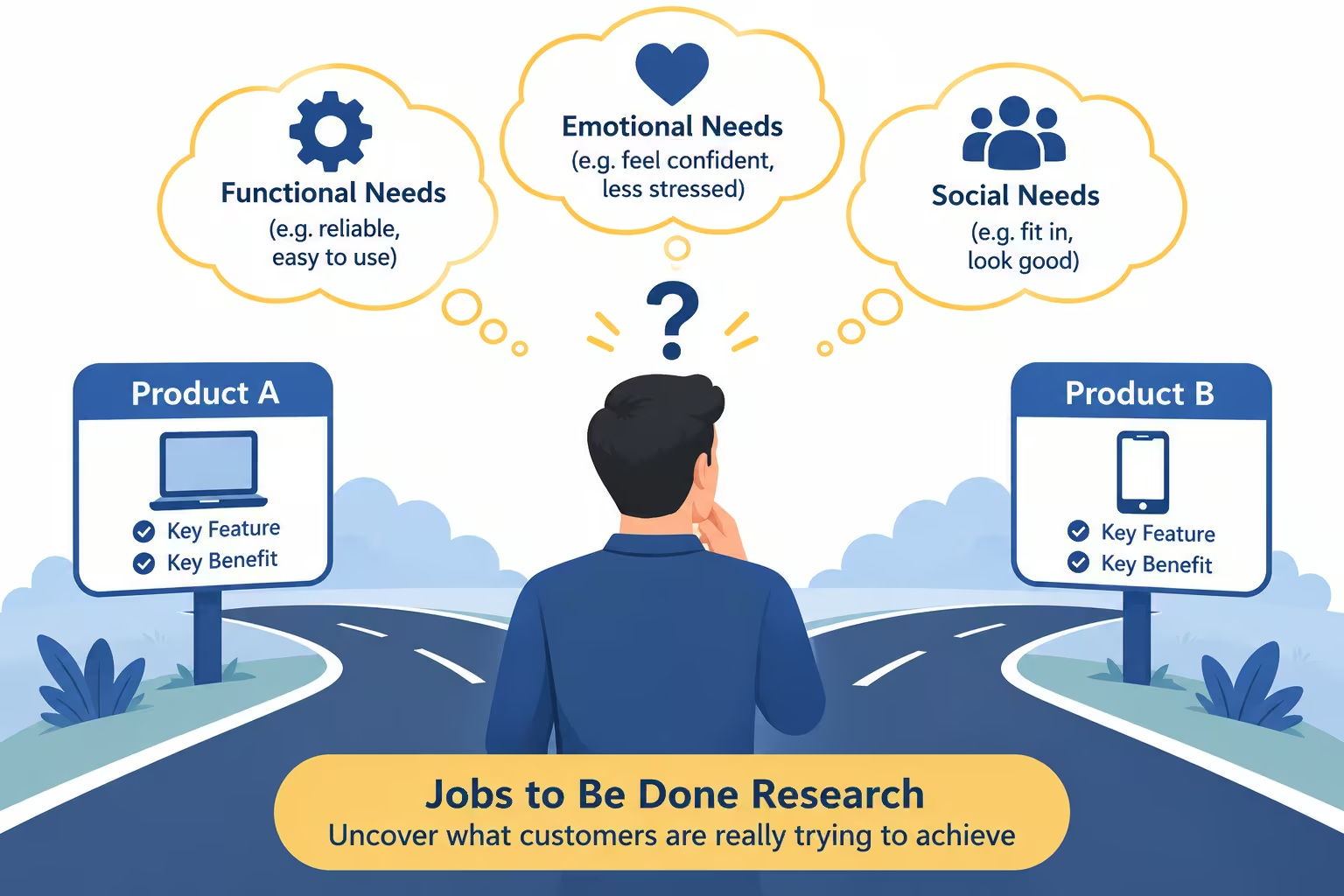
Jobs to be done research uncovers the progress customers are trying to make in a specific circumstance and the forces that lead them to hire or fire a solution. It shifts focus from demographics or feature lists to the functional, emotional and social dimensions of the job, giving product and strategy teams a clearer basis for innovation decisions.
What jobs to be done research actually measures
A job to be done is the progress a person seeks in a particular situation. Customers “hire” a product or service when it helps them make that progress and “fire” it when something else does the job better. The Christensen Institute describes Jobs to Be Done as a lens that reveals the circumstances and forces driving choices, rather than relying on market demographics or product attributes.
Every job has three dimensions: functional (the practical task), emotional (how the person wants to feel or avoid feeling) and social (how they want to be seen). Capturing only the functional layer is a common reason research fails to explain real switching behaviour.
Job statements are typically written in the form “When [situation], I want to [motivation], so I can [outcome].” The statement must stay solution-agnostic so it does not lock the team into the current product category.
When UK teams should use jobs to be done research
Use jobs to be done research when demographic segmentation or usage-and-attitude data does not explain why people switch, or when a new product or category is being considered. It is especially useful for:
- Identifying non-obvious competitors (including “do nothing” or workarounds).
- Prioritising which outcomes to improve before investing in features.
- Aligning product, marketing and research teams around the same customer progress.
- Validating whether a proposed innovation actually addresses an underserved job.
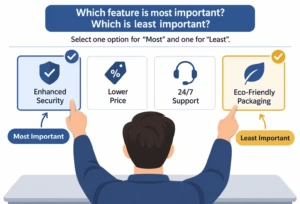
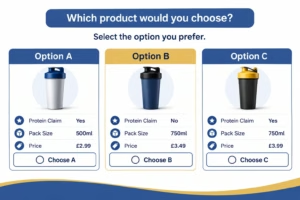
It is less efficient when the job is already well understood and the only remaining task is ranking known features, or when the decision timeline is too short for qualitative depth. In those cases, other methods such as MaxDiff or conjoint analysis may be more direct.
How to run a jobs to be done research study
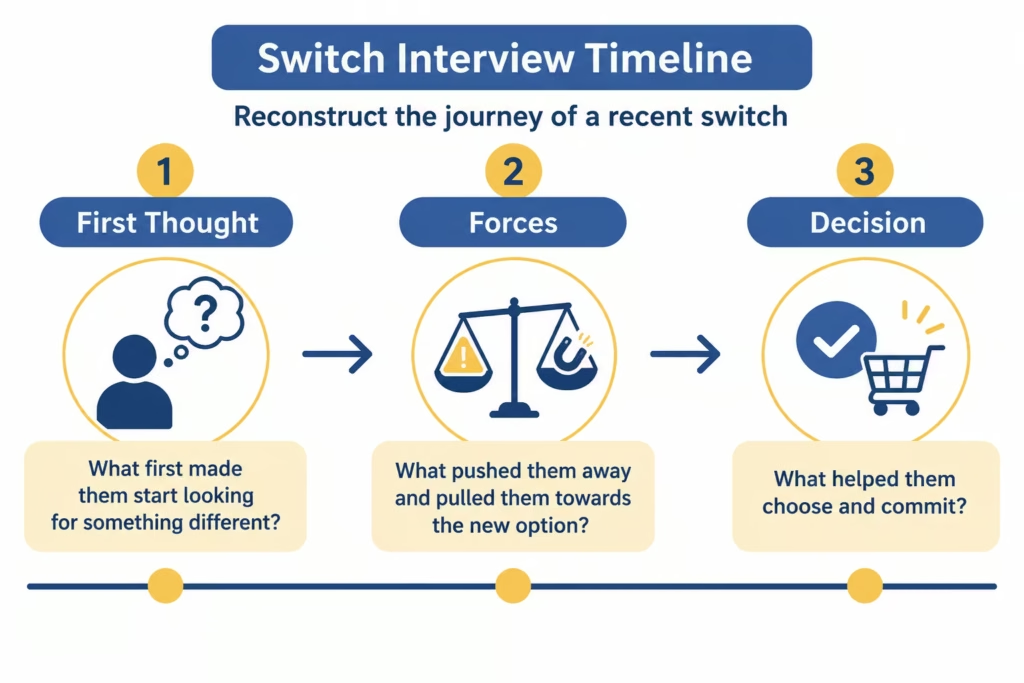
The most common qualitative method is the switch interview, associated with Bob Moesta. It reconstructs the timeline of a real recent switch (typically within the last 30–90 days) rather than asking people what they want.
Typical steps include:
- Recruit recent switchers (people who adopted or left a solution recently).
- Anchor on the first thought that started the search for something different.
- Walk the timeline event by event, noting push (problems with the status quo), pull (attraction of the new solution), anxiety and habit forces.
- Surface functional, emotional and social dimensions by asking what they worried about and who else was involved.
- Synthesise into clear job statements and competing solutions.
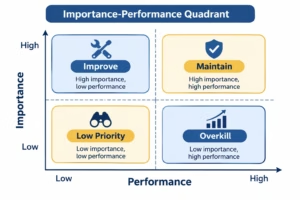
Once the job is defined, quantitative follow-up (for example outcome scoring in the Outcome-Driven Innovation approach) can measure importance and satisfaction to prioritise opportunities.
Three schools of JTBD and when to use each
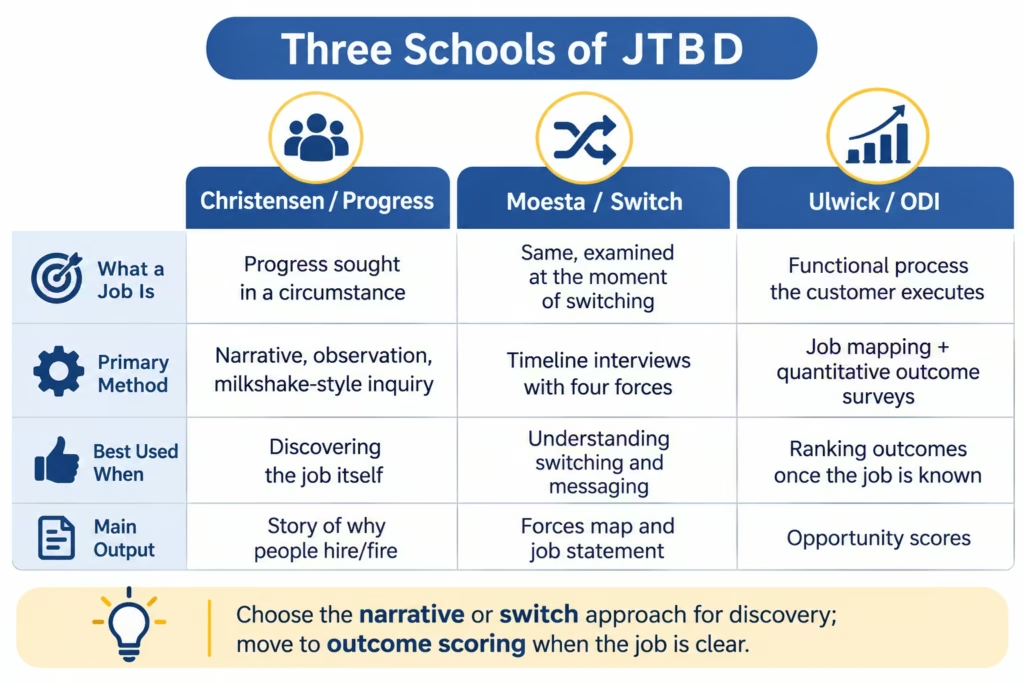
Three main schools exist. They answer different questions and should not be blended casually.
| School | What a job is | Primary method | Best used when | Main output |
|---|---|---|---|---|
| Christensen / progress | Progress sought in a circumstance | Narrative, observation, milkshake-style inquiry | Discovering the job itself | Story of why people hire/fire |
| Moesta / switch | Same, examined at the moment of switching | Timeline interviews with four forces | Understanding switching and messaging | Forces map and job statement |
| Ulwick / ODI | Functional process the customer executes | Job mapping + quantitative outcome surveys | Ranking outcomes once the job is known | Opportunity scores |
Choose the narrative or switch approach for discovery; move to outcome scoring when the job is clear and investment priorities are needed. Mixing vocabularies often produces contradictory guidance.
How JTBD differs from segmentation and U&A studies
Consumer segmentation research groups people by shared characteristics or behaviours. Usage and attitude studies measure how a category is used and what people think about it. Both are valuable, yet they often stop at “who” or “what” rather than the circumstance-driven “why” of a specific switch.
Jobs to be done research complements them. Segmentation can still identify reachable groups; JTBD explains the progress those groups are trying to make and reveals competitors outside the usual category. A competitive landscape analysis becomes sharper when the competitive set is defined by the job rather than by product type.
Common mistakes and limits
- Writing job statements that include the product category (they must be solution-agnostic).
- Collecting only functional statements and missing emotional or social drivers that explain willingness to pay.
- Interviewing people about general opinions instead of reconstructing a specific past switch.
- Treating all three schools as interchangeable.
- Expecting JTBD alone to size a market or predict share; it identifies opportunity but usually needs quantitative validation.
Jobs remain relatively stable over time, but the solutions customers hire change. Research findings therefore need refreshing when circumstances shift (for example new regulations or technology).
Frequently Asked Questionss
What is a switch interview?
A one-to-one conversation that reconstructs the timeline of a recent real switch, focusing on events, forces and circumstances rather than feature preferences.
How many interviews are typically needed?
Five to fifteen recent switchers often surface clear patterns for a single job; saturation is a better guide than a fixed number.
Does jobs to be done research replace personas?
No. Personas support empathy and communication; JTBD explains the progress and competing solutions that drive behaviour.
Can it be used in B2B markets?
Yes. The same principles apply when interviewing decision-makers or influencers about the progress their organisation is trying to make.
What comes after the qualitative stage?
Quantitative outcome scoring or other choice methods can prioritise which dimensions of the job are most underserved.
Conclusion
Jobs to be done research gives product and strategy teams a practical way to understand the progress customers are hiring solutions to achieve. By clarifying the job, the forces at work and the real competitive set, it reduces the risk of building features that do not move the needle.
AMC Insights supports teams with market and consumer understanding and innovation research that can incorporate jobs-to-be-done approaches alongside other methods. If you are deciding whether JTBD research is the right next step for a product or category decision, contact AMC Insights to discuss the fit.