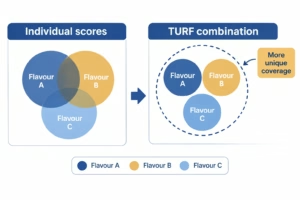
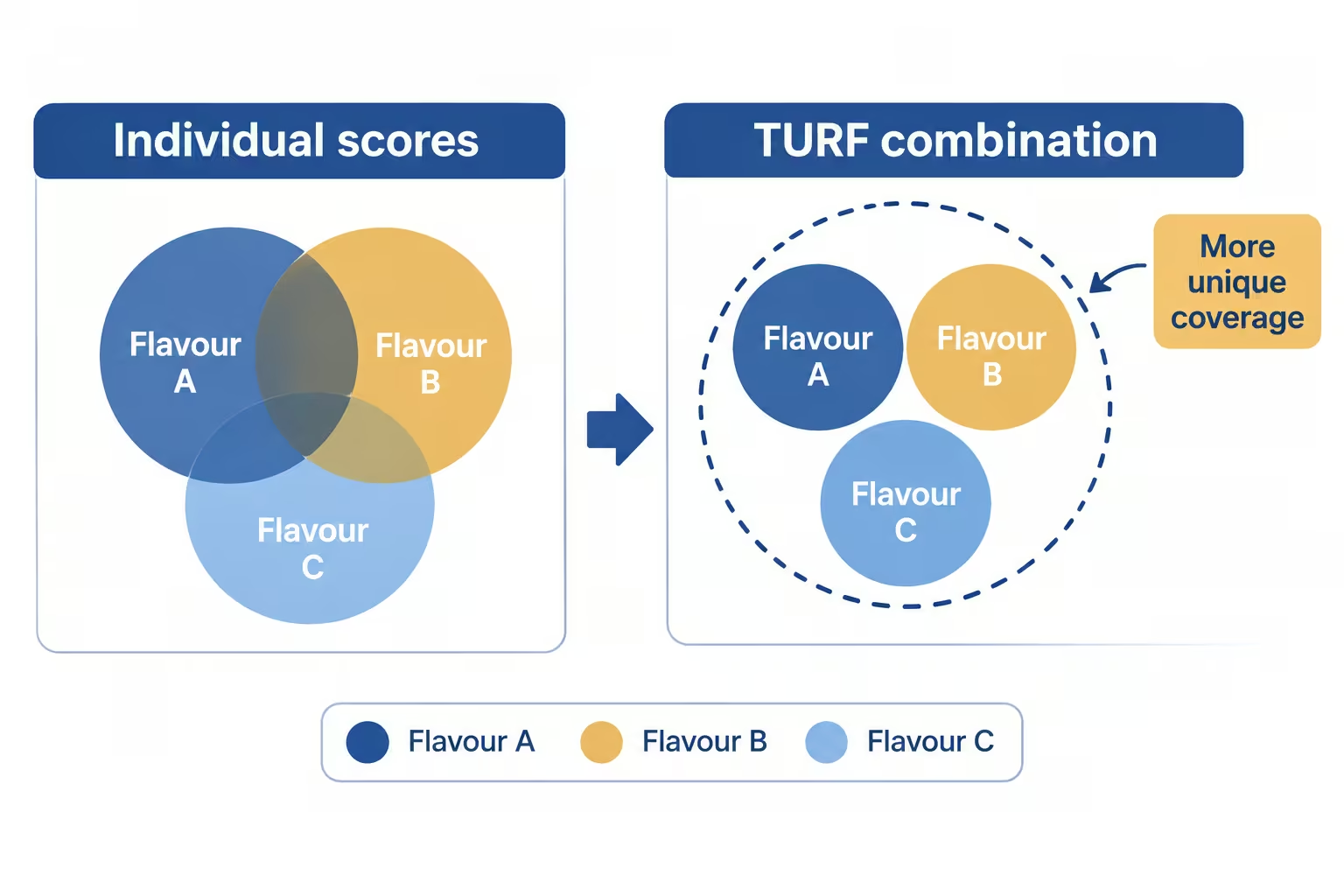
TURF analysis (Total Unduplicated Reach and Frequency) identifies the combination of products, flavours, features or messages that appeals to the largest share of people at least once. It looks at the portfolio as a whole rather than ranking items individually, so teams avoid choosing popular options that all appeal to the same buyers.
What Is TURF Analysis?
TURF analysis started in media planning, where the goal was to maximise the number of people who see at least one advertisement (reach) and how often they see it (frequency). Market researchers later adapted it for product ranges. When a company can only offer a limited number of variants, TURF calculates which subset covers the most unique people.
The core idea is unduplicated reach: the percentage of respondents who accept at least one item in a given combination. Frequency records how many items in the set each person accepts. In product-line work the focus is usually on reach; frequency matters more in media planning.
How TURF Analysis Works
Respondents first indicate which items they like, would buy or find acceptable. Common inputs include:
- Multi-select “which of these would you buy?” questions
- Top-two-box purchase intent on a rating scale, converted to yes/no
- Individual-level scores from a MaxDiff study, turned into accept/reject judgements
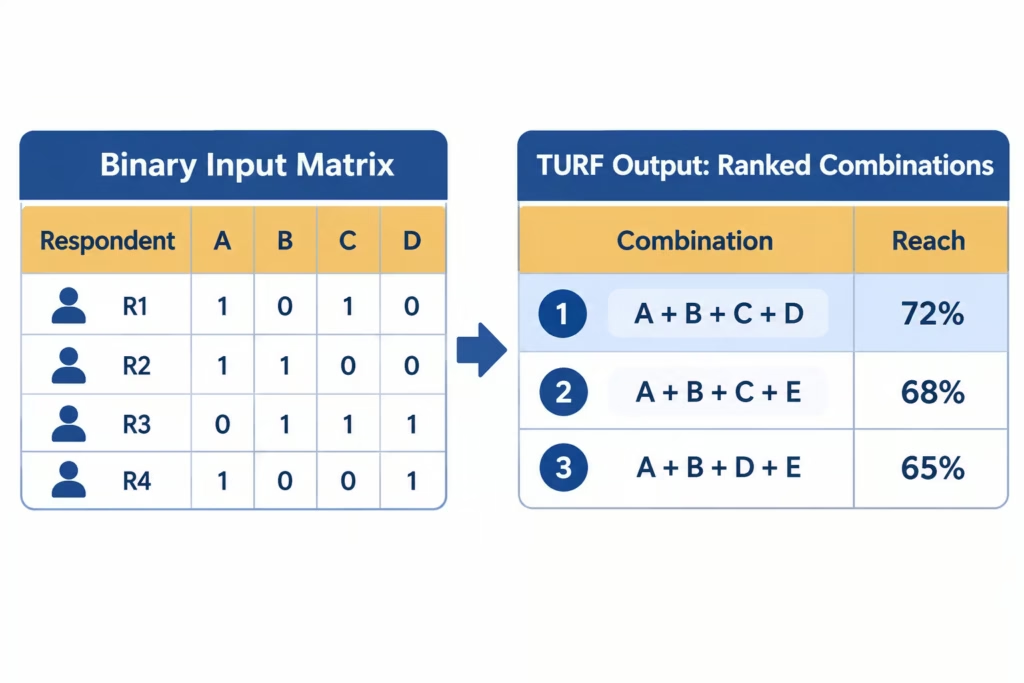
This creates a binary matrix (one row per person, one column per item, 1 = accepted, 0 = not). Software then tests combinations of a chosen size (for example the best 4 out of 12) and reports the one with the highest unduplicated reach. Exhaustive search checks every combination; greedy methods add one item at a time and are faster but not always optimal.
When to Use TURF Analysis
Use TURF when you face a constrained line-up decision:
- Limited shelf space, SKU slots or feature slots
- A long list of flavours, claims or variants where the top individual scores overlap heavily
- A need to maximise the share of people who find at least one acceptable option
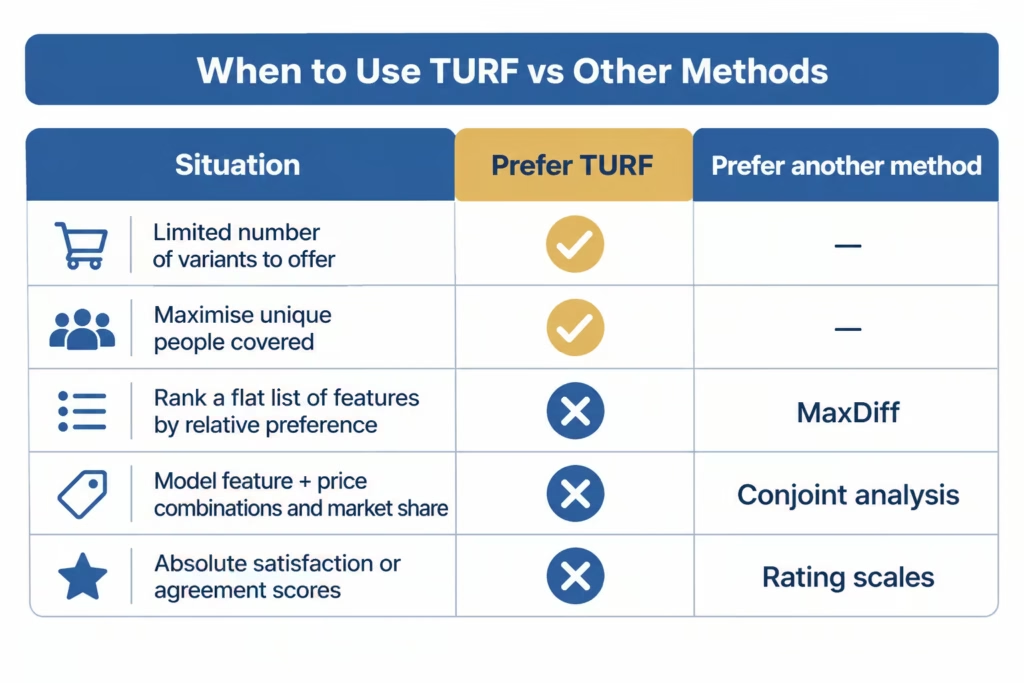
It is less useful when you need to understand how people trade features against price, or when absolute importance scores (not combinations) are required.
| Situation | Prefer TURF | Prefer another method |
|---|---|---|
| Limited number of variants to offer | Yes | — |
| Maximise unique people covered | Yes | — |
| Rank a flat list of features by relative preference | No | MaxDiff |
| Model feature + price combinations and market share | No | Conjoint analysis |
| Absolute satisfaction or agreement scores | No | Rating scales |
TURF vs MaxDiff and Conjoint
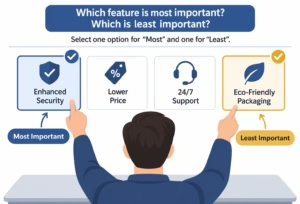
MaxDiff ranks individual items by relative preference. TURF then takes those (or other acceptance) judgements and finds the combination that covers the most people. They are often used together: MaxDiff shortlists or scores items, TURF optimises the final set.
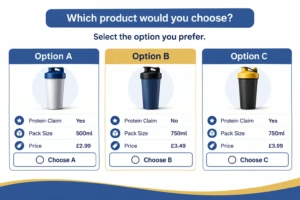
Conjoint analysis (or choice-based conjoint) presents complete product profiles and estimates how attributes trade off against each other, including price. It supports simulators; TURF does not. Teams sometimes run MaxDiff or simple multi-select first, then TURF for range decisions, and conjoint when pricing or bundling is the main question. See the guide on how conjoint analysis supports product and pricing decisions and the MaxDiff feature-prioritisation post for the complementary methods.
Practical Steps
- Define the decision and the maximum number of items you can offer.
- Create a clean list of comparable options (same level of specificity).
- Collect acceptance data from a sample large enough for the smallest differences you care about (Displayr notes that 100+ is a minimum and hundreds or more is preferable for strategic work).
- Convert answers to a binary matrix and run the optimisation.
- Review the top combinations, the incremental reach of each added item, and results by segment before locking the range.
Common Mistakes and Limits
- Treating the highest individual scores as the best combination (they often overlap).
- Missing data or poor binary conversion, which breaks the calculation.
- Ignoring frequency when the goal is depth of preference rather than simple reach.
- Applying TURF to decisions that really need price trade-offs or market-share simulation.
TURF shows relative coverage of the items you tested. It does not prove that any item will succeed in market, nor does it replace behavioural data or competitive response. Sample quality and the definition of “accept” strongly influence results.
Hypothetical example (not an AMC project): a UK snack brand can stock only four of twelve new flavour ideas. Individual preference scores put two popular flavours at the top, but TURF shows they appeal to almost the same people. Swapping one for a lower-ranked but less overlapping flavour increases unduplicated reach by several points, covering more unique shoppers with the same shelf space.
Frequently Asked Questions
What does TURF stand for?
Total Unduplicated Reach and Frequency.
How large a sample is typically needed?
At least 100 respondents is a common minimum; larger samples (hundreds) are preferable when small differences in reach matter.
Can TURF use MaxDiff data?
Yes. Individual MaxDiff scores are often converted into accept/reject judgements and then fed into TURF.
Does TURF replace conjoint analysis?
No. TURF optimises a limited portfolio for reach; conjoint models attribute trade-offs and price.
What are the main limits?
Results depend on how “acceptance” is defined and on sample quality. They do not forecast actual sales or account for competitive reaction.
Conclusion
TURF analysis is the practical tool when the question is “which limited set of options covers the most unique people?” rather than “which single item is most preferred?” or “how do features trade off against price?” Combine it with MaxDiff for prioritisation or conjoint for packaging and pricing when the decision requires those outputs.
AMC Insights supports product-range and innovation decisions through market research services and innovation and product development support. Offices are in London and Riyadh. Contact AMC Insights to discuss whether TURF, MaxDiff or another method fits an upcoming range decision.