
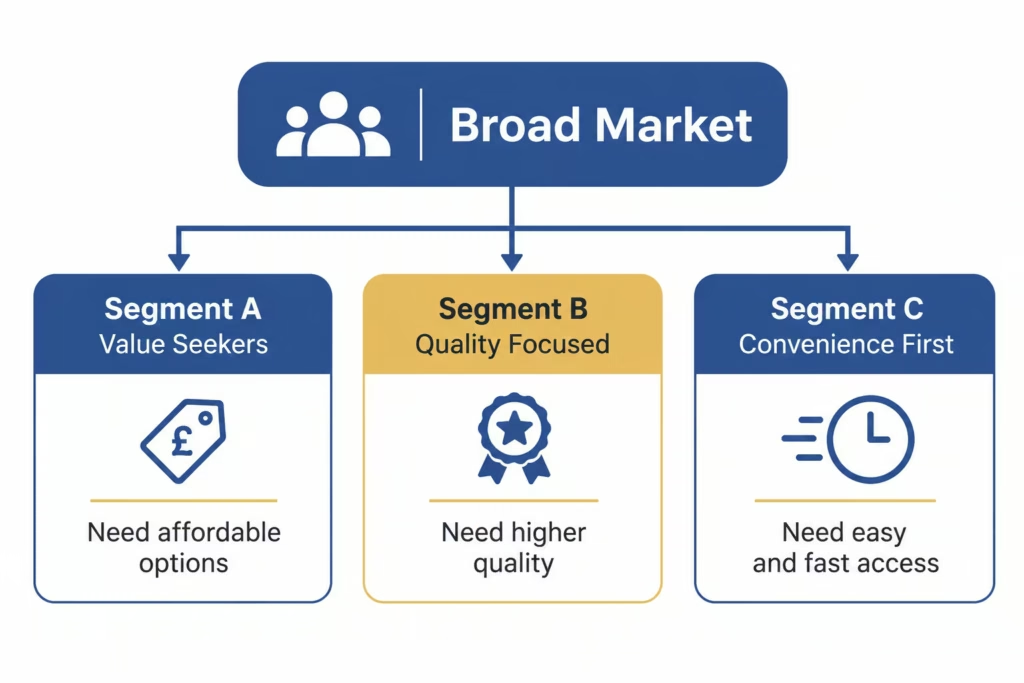
Consumer segmentation research is the structured process of dividing a market or customer base into distinct groups that share similar needs, behaviours, attitudes or other characteristics relevant to a decision. UK teams use it to move beyond broad averages and design offers, messages and channels that fit real differences in how people buy or use a category.
It answers which groups exist, how large and valuable they are, what drives their choices, and how an organisation can reach or serve them differently. Findings reduce the risk of one-size-fits-all strategies that ignore important variation.
Why UK organisations commission consumer segmentation research
Many categories contain meaningful differences that simple demographics miss. Two people of similar age and income may have entirely different reasons for choosing a product, different barriers, or different preferred channels. Segmentation research makes those differences visible and measurable so resources can be allocated more effectively.
Typical triggers include launching or repositioning a product, diagnosing why growth has stalled in one part of the base, entering a new channel, or building a foundation for later concept or messaging tests. The work is most useful when the business decision is clear in advance, for example which segments to prioritise for a new offer or which attributes to emphasise in communications.
Common bases for segmentation
Researchers choose the basis that best predicts the decision at hand.
Needs-based segmentation groups people by the jobs they want done or the problems they need solved. It is often strongest for product and positioning decisions. Behavioural segmentation uses observed or reported actions such as purchase frequency, channel use or repertoire. Attitudinal or psychographic segmentation clusters people by values, motivations or choice criteria. Demographic or firmographic variables are useful for targeting and media but rarely explain why people behave as they do on their own.
Most practical studies combine a primary basis (often needs or attitudes) with descriptor variables so the resulting segments can be found and reached.
How a typical study is designed and run
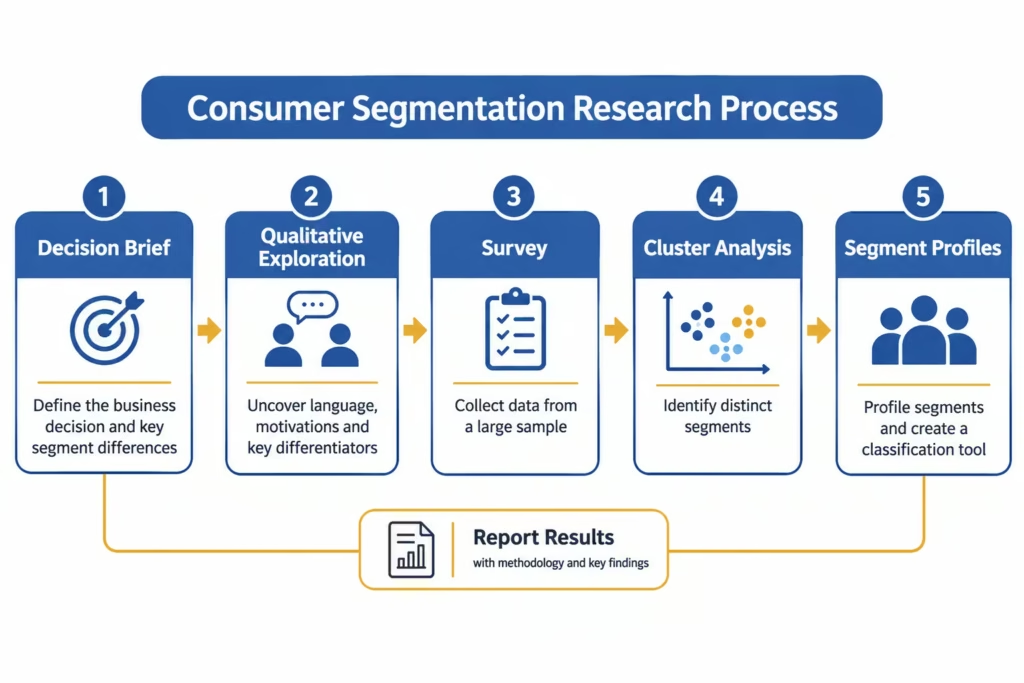
Start with the decision the research must support and the minimum segment differences that would change that decision. Short qualitative interviews or discussion groups then identify the language people use, the occasions that matter, and the variables likely to differentiate groups.
A quantitative survey follows, usually with a sample large enough for reliable subgroup analysis. The questionnaire covers the primary basis variables, current behaviour, brand or product perceptions, barriers and demographics. Analysis typically uses factor analysis to reduce related questions, then cluster analysis (or latent class methods) to form groups. The number of segments is chosen by statistical fit, interpretability and commercial usefulness rather than a fixed target.
Segments are profiled with size, value indicators, key needs, behaviours and attitudes. A short classification tool or set of questions is often developed so the organisation can identify segment membership in future work or customer data. Results are reported with clear sample details, method, geography and date so users can judge confidence levels.
What findings typically support
Well-executed segmentation research helps teams prioritise which groups to target first, which product or service features matter most to each, and how messaging or channel choices should differ. It can also reveal that some assumed differences are small or that a large segment is poorly served by current offers.
Findings are most actionable when they are linked to concrete next steps, for example which concepts to test with specific segments or which experience gaps to close. They do not guarantee sales growth; they reduce uncertainty around targeting and design choices.
Market and consumer understanding services can support the design, fieldwork and interpretation of segmentation studies. Related market research services cover the qualitative and quantitative methods commonly used.
Limitations and common mistakes
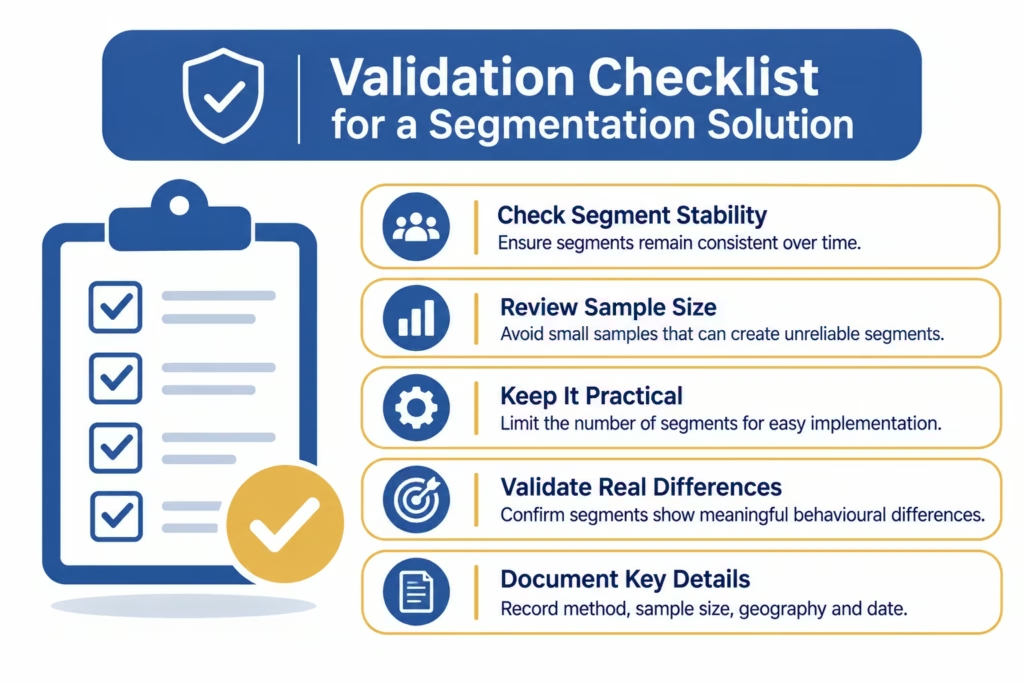
Segments are statistical constructs, not fixed human types. They can shift as markets or behaviours change, so they need periodic review. Small samples produce unstable clusters. Overly complex solutions with many segments are hard to implement. Treating demographic groups as segments without testing whether needs or behaviours actually differ leads to weak targeting.
Results depend on the questions asked and the sample reached. Always state method, sample size, geography and date. Stated attitudes do not always match real behaviour, so triangulation with usage data or later validation is valuable. Implementation requires cross-team agreement on how segments will be used in product, marketing and service decisions; research alone does not create that alignment.
How this fits with other research
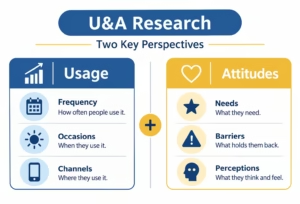
Segmentation research often builds on or sits alongside broader studies such as usage and attitude research, which provides category context on behaviour and needs. It can also inform later concept testing or brand positioning work by showing which groups value different attributes.
For organisations that need structured support, the practical next step is to define the decision, review existing data, and scope a study that matches the required confidence level and timeline. Contact the team to confirm current scope and availability for a specific brief.
Frequently Asked Questions
What is the main difference between consumer segmentation research and simple demographic targeting
Consumer segmentation research tests whether groups differ on needs, behaviours or attitudes that matter to a decision. Demographic targeting uses variables such as age or income without confirming those differences drive choice.
When should a UK business commission consumer segmentation research?
It is useful before major product, positioning or channel decisions when existing data or assumptions do not clearly show which groups exist and how they differ in ways that affect the decision.
How large a sample is typically needed?
It depends on the number of segments and the precision required for subgroup analysis. Consumer studies often need several hundred to a few thousand respondents so smaller segments remain analysable. Exact size is set by the research design and decision stakes.
Can segmentation research be done with existing customer data alone?
Internal data can identify behavioural groups, but it usually misses non-customers and the underlying needs or attitudes. Combining survey data with internal data often produces more useful and reachable segments.