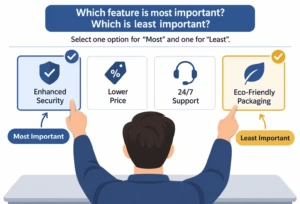
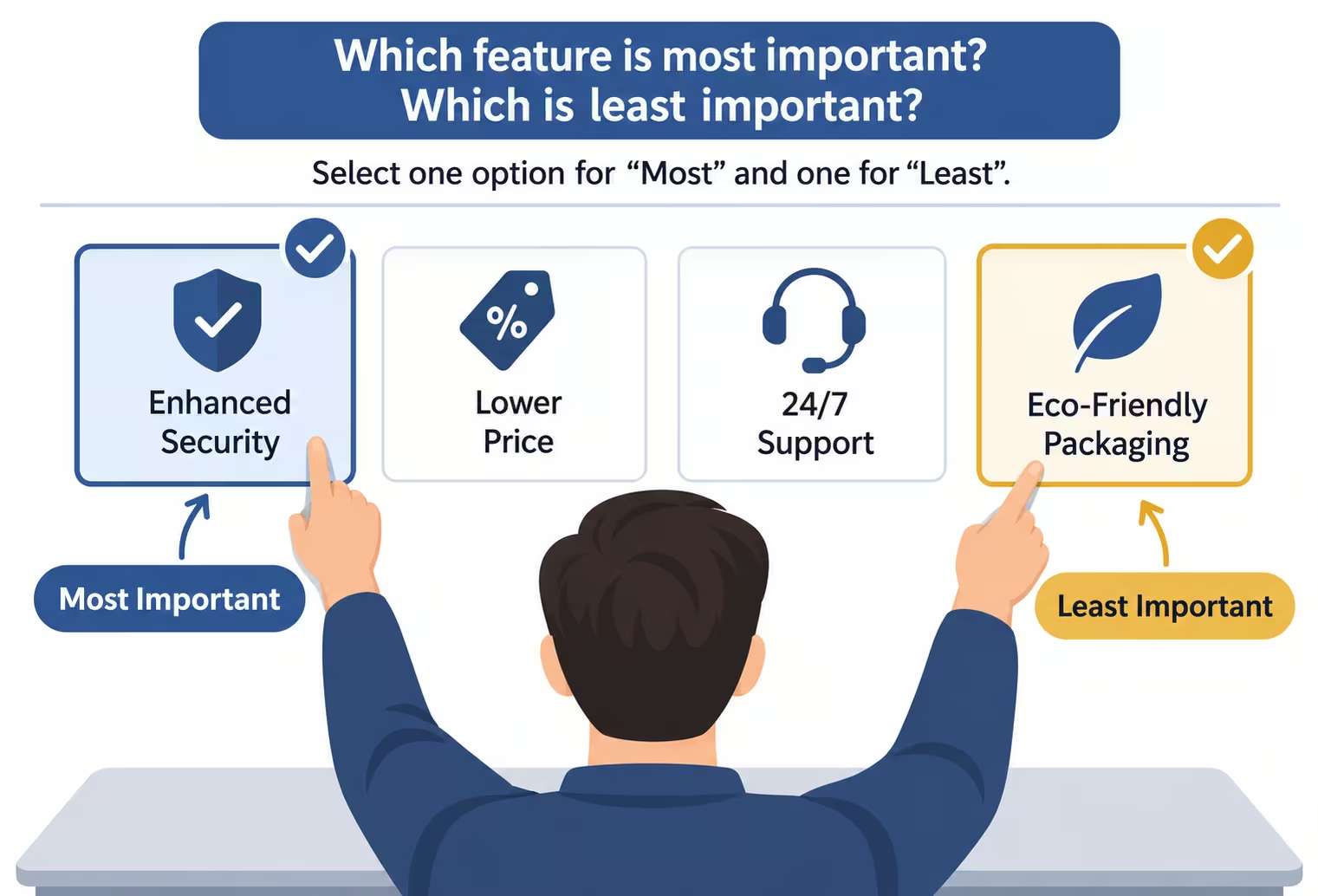
MaxDiff analysis (maximum difference scaling, also called best-worst scaling) is a survey method that ranks a list of items by asking people to choose the most and least preferred option from small rotating sets. It produces clear relative preference scores that separate what matters most from what does not, avoiding the problem where almost everything scores “important” on a rating scale.
Product, innovation and marketing teams use it when they have 10–30 candidate features, claims, messages or benefits and need a reliable order before committing development or campaign resources. It is especially useful early in new product development when a long list of ideas exists but budget and time are limited.
What Is MaxDiff Analysis?
MaxDiff was developed by Jordan Louviere in 1987. Respondents see small sets (typically 3–5 items, most often 4 or 5) drawn from a longer master list. For each set they select the best (most important, most appealing) and the worst (least important, least appealing) item. The process repeats across multiple sets so every item is shown several times in different combinations.
Because each choice is a forced trade-off, the method avoids scale-use bias. One person’s “important” is not another person’s “very important,” and respondents cannot rate everything highly. The resulting scores are relative: an item that scores twice as high is preferred roughly twice as strongly within the tested list. Scores do not measure absolute importance or willingness to pay.
AMC Insights supports product and innovation decisions through its Innovations and Product Development services and broader market research services, which include MaxDiff and related quantitative techniques.
How MaxDiff Works
A balanced experimental design ensures each item appears equally often and pairs with other items roughly equally. Software usually generates the design; hand-built sets risk uneven exposure and biased scores.
Simple count scoring works for a first look:
Score = (times chosen best − times chosen worst) ÷ times shown.
Scores range from −1 to +1 and sum to zero across items. More advanced analysis (hierarchical Bayes or multinomial logit) produces individual-level utilities that support segment comparisons.
The output is a ranked list with preference shares or utilities. Teams look for natural breaks (clear leaders, middle pack, clear drop-offs) rather than treating every rank difference as equally meaningful.
When to Use MaxDiff (Decision Framework)
Use MaxDiff when the decision is “which of these standalone items matter most?” and you need differentiation that rating scales do not provide.
| Situation | Prefer MaxDiff | Prefer another method |
|---|---|---|
| Long flat list of features, claims or messages (10–30 items) | Yes | — |
| Need relative ranking only | Yes | — |
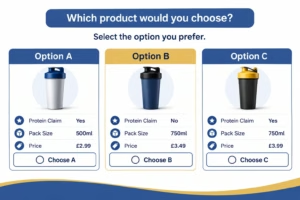
| Need trade-offs between combinations or price | No | Conjoint analysis |
| Need absolute satisfaction or agreement | No | Rating scales |
| Need maximum unduplicated reach of a portfolio | No | TURF analysis |
| Fewer than ~7–8 items | Often unnecessary | Simple ranking |
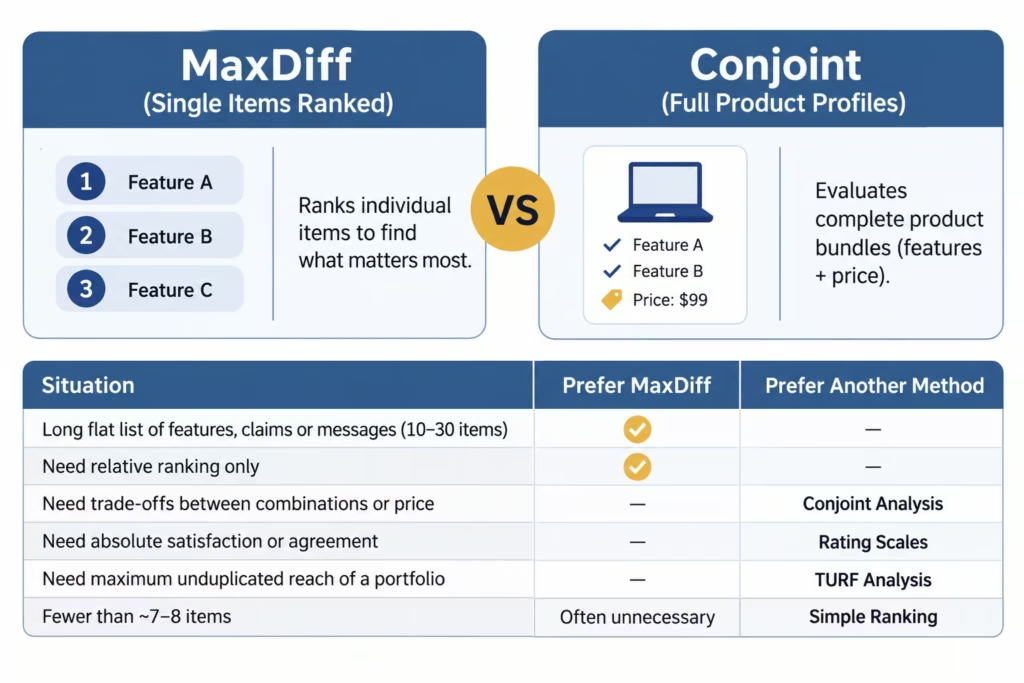
Many teams run MaxDiff first to shortlist, then move the top items into a conjoint study that tests combinations and pricing. MaxDiff does not measure willingness to pay; pair it with methods such as Gabor-Granger or Van Westendorp if price is the next question. See related guidance on pricing research with the Gabor-Granger method and product concept testing.
How to Design a MaxDiff Study
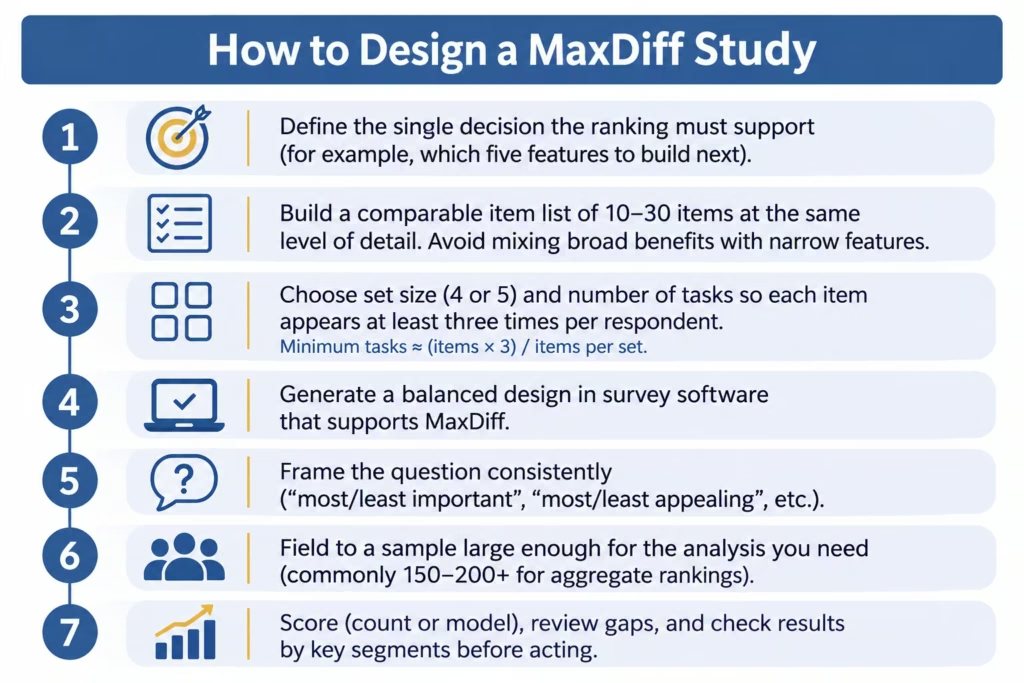
- Define the single decision the ranking must support (for example, which five features to build next).
- Build a comparable item list of 10–30 items at the same level of detail. Avoid mixing broad benefits with narrow features.
- Choose set size (4 or 5) and number of tasks so each item appears at least three times per respondent. Rough formula: minimum tasks ≈ (items × 3) / items per set.
- Generate a balanced design in survey software that supports MaxDiff.
- Frame the question consistently (“most/least important”, “most/least appealing”, etc.).
- Field to a sample large enough for the analysis you need (commonly 150–200+ for aggregate rankings; more for reliable segment splits).
- Score (count or model), review gaps, and check results by key segments before acting.
Pilot the wording with a small group. Overlapping or vague items split votes and weaken both.
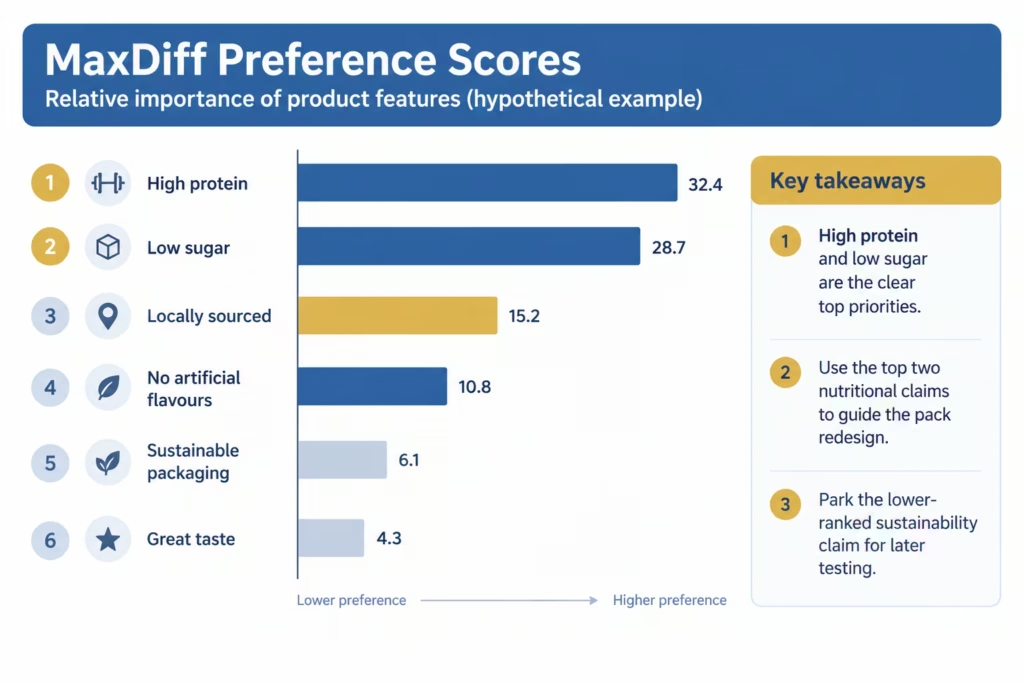
Hypothetical example, not an AMC project: A UK food brand tests 15 packaging claims. MaxDiff shows “high protein” and “low sugar” clearly ahead of “locally sourced.” The team leads the pack redesign with the top two nutritional claims and parks the lower-ranked sustainability claim for later testing.
Common Mistakes and Limits
- Too few exposures per item (scores become unstable).
- Mixing non-comparable items or including price inside the list.
- Treating the top-ranked item as absolutely important (it is only the best of the tested set).
- Ignoring segment differences that an overall ranking can hide.
- Using MaxDiff when the real question is about combinations, price sensitivity or portfolio reach.
MaxDiff is relative, not absolute. It does not replace concept testing, usage-and-attitude research or in-market validation. How market research supports new product development places methods like this in the wider process.
Frequently Asked Questions
What is the difference between MaxDiff and best-worst scaling?
They refer to the same method in practice. Best-worst scaling is the broader academic term; MaxDiff is the common market-research name.
How many items should a MaxDiff study include?
Typically 10–30. Below that, simple ranking is often enough. Above 30 the survey length or exposure per item suffers unless a sparse design is used.
How many respondents are needed?
Around 150–200 usually supports a stable aggregate ranking. Segment-level or individual-level analysis needs larger samples (often 200+ per key segment).
Can MaxDiff measure willingness to pay?
No. It ranks items on a single preference dimension. Price trade-offs require conjoint or a dedicated pricing method.
Is MaxDiff better than a rating scale?
For prioritisation of longer lists, yes, because it forces trade-offs and reduces scale bias. Rating scales remain useful when you need absolute levels of satisfaction or agreement.
Conclusion
MaxDiff analysis gives product and innovation teams a clear, relative ranking of features, claims or messages when rating scales fail to differentiate. Use the decision framework above to confirm it matches the question, follow the design checklist, and sequence it with conjoint or pricing research when combinations or price matter.
If you need help designing or analysing a MaxDiff study as part of a broader product or market research programme, contact AMC Insights.