
B2B market research is the structured collection and analysis of evidence from people who buy or influence purchases on behalf of organisations. It helps UK teams decide on markets, offers, pricing and positioning when the cost of being wrong is high.
What B2B market research actually covers
Unlike consumer research, B2B market research focuses on professional roles, organisational needs and multi-person buying processes. Participants answer as representatives of their company rather than as private individuals.
Typical questions include the size and structure of a market, the criteria used by different roles in the decision-making unit, current solutions and their shortcomings, and willingness to pay or switch. Methods range from desk research using published statistics and reports to primary work such as interviews and surveys.
The Market Research Society (MRS) publishes guidelines for business-to-business research that interpret its Code of Conduct. These emphasise transparent purpose, participant protection and accurate reporting. UK projects should also respect UK GDPR and the Data Protection Act 2018; legal advice should be sought for specific data-handling questions.
How B2B research differs from consumer research
Consumer research often works with large samples of individuals making relatively low-value, personal decisions. B2B research usually involves smaller, harder-to-reach populations and longer, higher-value buying cycles.
Key differences include:
- Sample size and access: senior decision-makers are fewer and more expensive to reach.
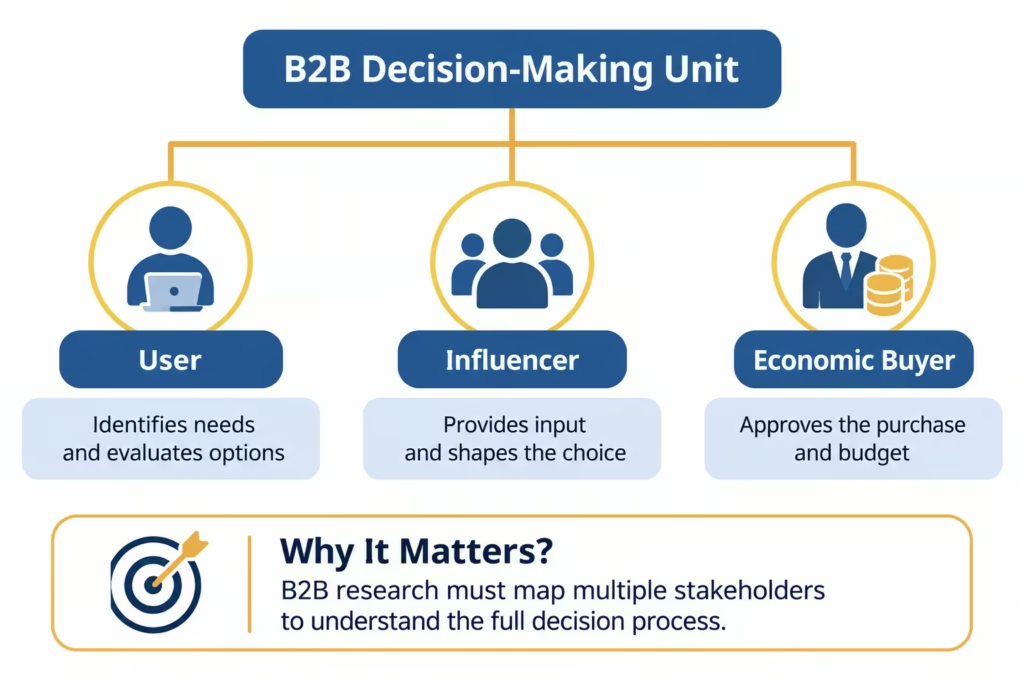
- Decision complexity: multiple roles (users, influencers, budget holders) must often be understood separately.
- Stakes and timelines: outcomes frequently affect contracts, capital expenditure or market entry rather than single purchases.
- Language and stimuli: materials must reflect professional contexts rather than lifestyle or emotional consumer language.
These differences mean that methods, sample design and analysis need to be adapted. A survey approach that works for a consumer brand may produce low response or misleading results if applied unchanged to a B2B audience.
When UK firms typically need B2B market research
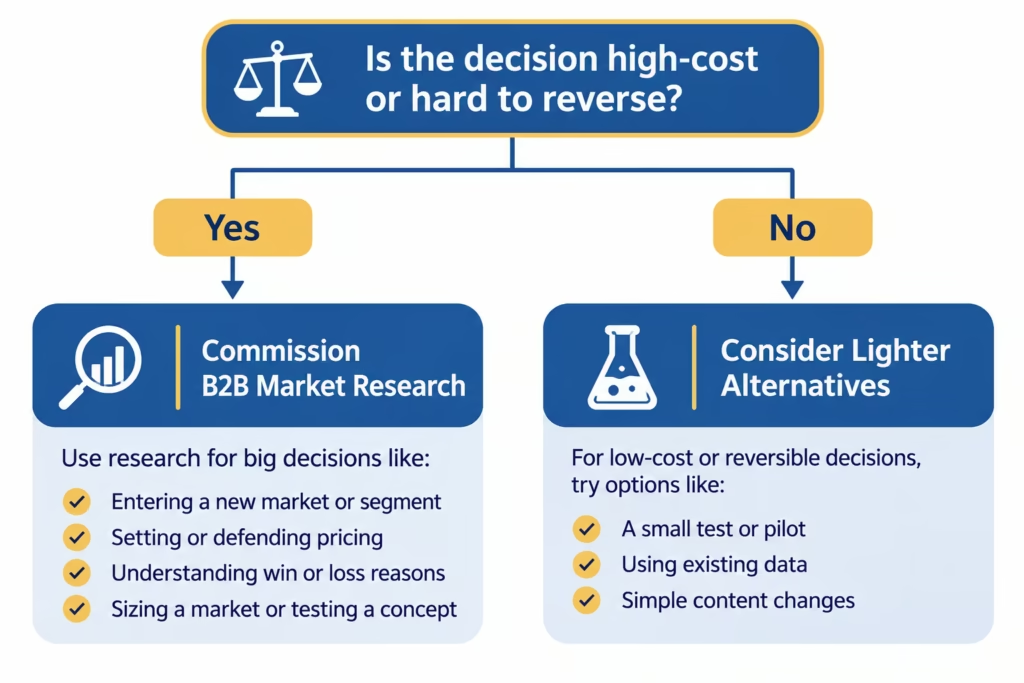
B2B market research is most useful when a commercial decision is costly or difficult to reverse and internal data alone is insufficient. Common triggers include:
- Entering a new vertical, geography or customer segment.
- Defining or validating an ideal customer profile and the jobs different roles need done.
- Setting or defending pricing, packaging or service levels.
- Understanding why deals are won or lost (win-loss analysis).
- Sizing a market or assessing competitive intensity before investment.
- Testing messaging or concept appeal with the actual buying committee.
If the decision is low-cost and easily reversible (for example, a minor website copy test), lighter methods or live experimentation may be enough. Research is less efficient when the main need is simply to organise data the organisation already holds.
Typical methods and practical limits
Secondary research draws on official statistics, industry reports, company filings and competitor public materials. It is useful for orientation but rarely answers organisation-specific questions.
Primary methods commonly include:
- In-depth interviews with decision-makers or influencers (often 8–15 per segment for exploratory work).
- Structured surveys once the language and key issues are clear.
- Win-loss interviews shortly after real deals close.
- Segmentation or choice-modelling studies when the sample and budget allow.
Limitations are important. Small samples cannot support precise percentage claims. Hard-to-reach senior respondents may introduce selection bias. Findings reflect the time period and population studied; they do not guarantee future behaviour. AI tools can speed analysis of open text but still require human validation for accuracy, relevance and bias.
Results are most valuable when they are linked to a clear decision and accompanied by stated confidence levels and remaining uncertainties. Business-to-Business services at AMC Insights include industry reports and market sizing that often sit alongside primary B2B research. Broader market research services supply the qualitative and quantitative methods used in these studies.
Turning findings into decisions
A practical next step is to document the business decision first, then design research that can reduce the main uncertainties around it. Share the decision context with any external supplier so the design stays focused.
UK teams can review published service pages and then contact AMC Insights (London and Riyadh offices; info@amc-insights.com) to discuss whether a particular brief fits current capabilities. Availability of specific methods or coverage should be confirmed for each project.
Frequently Asked Questions
What is B2B market research?
B2B market research is the systematic gathering and analysis of information from people who buy or influence purchases on behalf of organisations. It examines market structure, buyer needs, decision criteria and competitive alternatives to support commercial decisions.
When should a UK company commission B2B research rather than rely on internal knowledge?
Commission it when the decision is high-cost or hard to reverse and existing internal data cannot answer the key uncertainties. Examples include market entry, pricing changes, or validating a new ideal customer profile.
How does B2B research differ from ordinary consumer research?
B2B research typically involves smaller samples, multiple decision-makers, longer buying cycles and higher-value outcomes. Methods and recruitment must account for professional roles and organisational context rather than individual consumer behaviour.
What professional standards apply in the UK?
The Market Research Society Code of Conduct and its B2B guidelines set expectations on transparency, participant protection and reporting. Projects must also comply with UK data-protection law; specific legal questions require qualified advice.