
Shopper insights research examines the motivations, triggers, barriers and behaviours that shape purchase decisions at the point of sale, whether in a physical store or online. It focuses on the shopper in the moment of choice rather than on broader attitudes or product usage.
Why Shopper Insights Research Matters for UK Businesses
UK retail remains competitive and channel-fragmented. Official statistics show fluctuating retail sales volumes and ongoing shifts between in-store and online spend. The Office for National Statistics Retail Sales Index tracks these patterns for Great Britain and provides a public reference for overall category movement.
Shopper insights research helps brands and retailers understand why volume moves in one direction or another at the shelf or checkout. It supports decisions on ranging, packaging, pricing cues, promotions, planograms and digital shelf presentation. Findings reduce reliance on sales data alone, which shows what sold but not why an alternative was rejected.
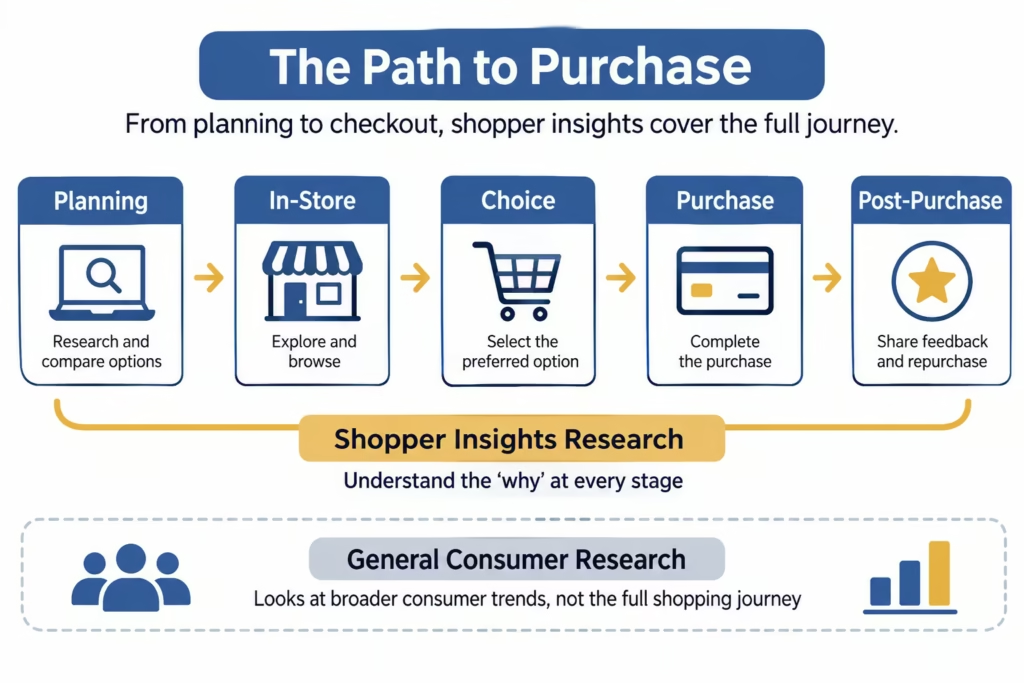
How Shopper Insights Differ from Broader Consumer Insights
Consumer insights research typically explores needs, attitudes, brand associations and product usage across the wider relationship with a category. Shopper insights research narrows to the purchase occasion: mission, channel choice, in-aisle navigation, decision hierarchy and the influence of price, promotion, placement and pack design.
The two are complementary. A consumer study may reveal growing interest in a health attribute; shopper insights research tests whether that interest translates into choice when the product sits beside established alternatives on the shelf or in a search result. Stated preferences collected away from the purchase context often differ from observed behaviour at the point of sale.
Common Methods Used in Shopper Insights Research
Researchers select methods according to the decision and the category.
Qualitative approaches include accompanied shopping trips, in-depth interviews shortly after purchase, and focus groups that use stimuli such as planograms or digital shelf images. These reveal language, unstated trade-offs and the role of context.
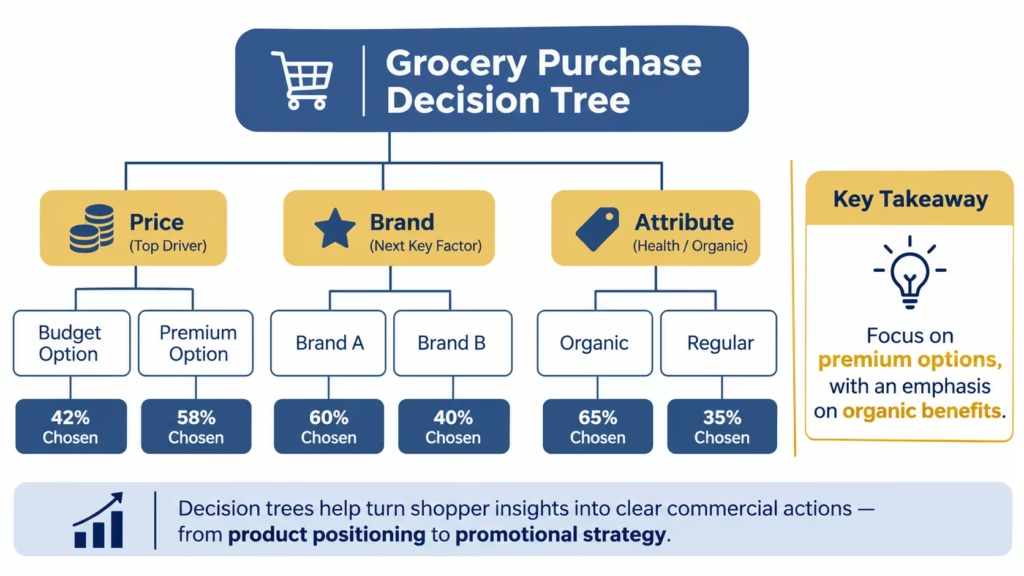
Quantitative approaches include exit or intercept surveys, online surveys of recent buyers, and structured choice tasks that measure attribute importance. Decision-tree analysis is a common output that ranks the sequence of factors shoppers use to narrow options.
Observational or passive techniques such as eye-tracking or heat-map analysis can show visual attention, provided ethical consent and privacy rules are followed. Transaction and loyalty data supply behavioural evidence but require careful interpretation because they lack the “why”.
Most useful studies combine methods and state sample size, geography, date and recruitment criteria.
How Findings Inform Practical Decisions
Clear shopper insights support specific commercial choices. Examples include which claims or pack features to emphasise, whether a promotion lifts volume or merely shifts brand share, how shelf adjacency affects trial, and which channel or mission a product best serves.
Results typically feed range reviews, retailer negotiations, creative briefs and short-term activation plans. They also flag where further testing (for example a limited store trial) is needed before wider investment. Market and consumer understanding services can design and interpret this work for UK brands and retailers. Related market research services supply complementary sizing or competitive analysis when required.
Limitations and Common Mistakes
Shopper behaviour is context-specific. Findings from one retailer, region or season do not automatically transfer. Sample bias arises when recruitment misses light buyers or online-only shoppers. Over-reliance on self-reported reasons without behavioural validation can mislead. AI tools that summarise open comments still require human review for accuracy, relevance and bias.
Always report method, sample and date. Treat results as evidence that reduces uncertainty, not as a guarantee of sales uplift. Privacy obligations under UK GDPR apply to any personal data collected; qualified legal advice is recommended for programme design.
Practical Next Steps for UK Teams
Define the commercial decision and the shopper definition first. Map existing internal data (sales, loyalty, complaints). Choose the lightest method that can answer the question. Plan for both qualitative depth and quantitative scale when the decision is high-stakes. Validate key findings against observed behaviour where possible.
Organisations that need structured support can review market and consumer understanding or contact AMC Insights to discuss a specific brief. Related path-to-purchase questions are addressed in customer journey analysis.
Conclusion
Shopper insights research focuses on the moment of choice. When designed with clear objectives, appropriate methods and transparent limitations, it helps UK teams make better-informed decisions on ranging, placement, promotion and channel. It works best alongside broader consumer and market evidence rather than in isolation.
Frequently Asked Questions
What is the main difference between shopper insights and consumer insights?
Shopper insights research examines purchase behaviour and decision factors at the point of sale. Consumer insights research looks more broadly at needs, attitudes and usage outside the immediate shopping trip.
When should a UK brand commission shopper insights research?
It is useful before major range or packaging changes, when entering a new retailer or channel, or when sales data show unexpected shifts that need explanation.
Can shopper insights research be done online as well as in-store?
Yes. Online studies examine search, digital shelf, price comparison and checkout behaviour. Methods and stimuli differ from physical-store observation.
How long does a typical shopper insights study take?
Qualitative work can often be completed in three to six weeks. Quantitative surveys or multi-method studies commonly take four to eight weeks depending on sample and analysis.