
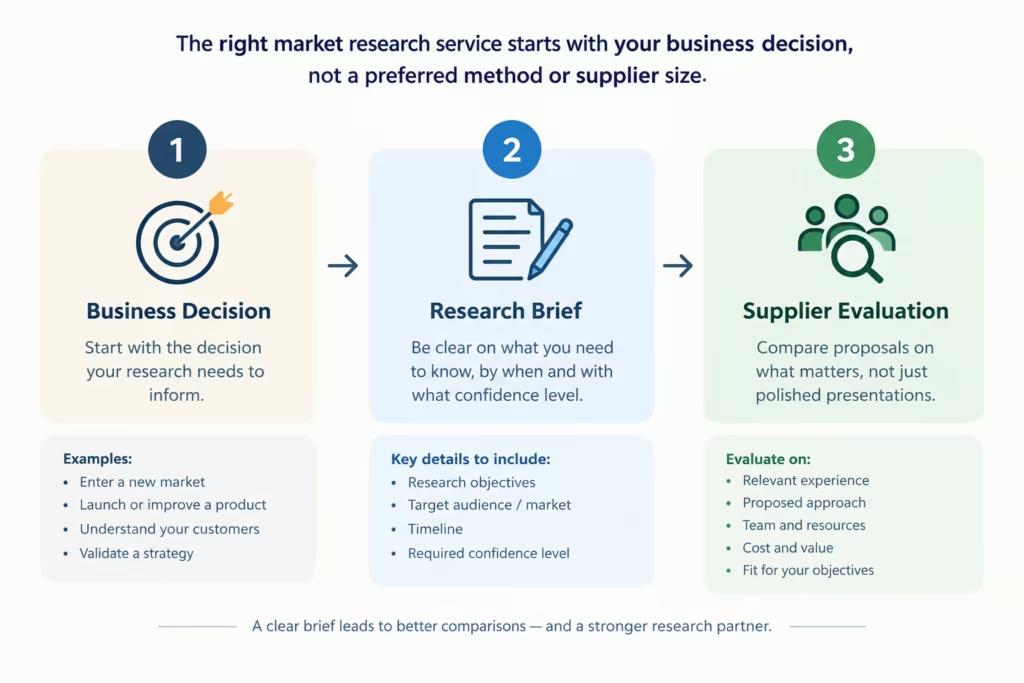
Choosing the right market research services starts with the business decision the work must inform, not with a preferred method or supplier size. A clear brief on what you need to know, by when and with what confidence level, lets you compare proposals on relevant criteria rather than on polished presentations alone.
Define the Decision Before You Brief Suppliers
State the specific decision or risk the research should reduce. Examples include whether to enter a new category in the UK, which product features matter most to buyers, or how customers currently experience a service.
This focus stops the brief expanding into general “market understanding” that is hard to act on. It also makes it easier to judge whether a supplier’s proposed approach will produce usable evidence.
Market research services that match a defined decision tend to be more cost-effective than broad exploratory work.
Match Methods to the Question
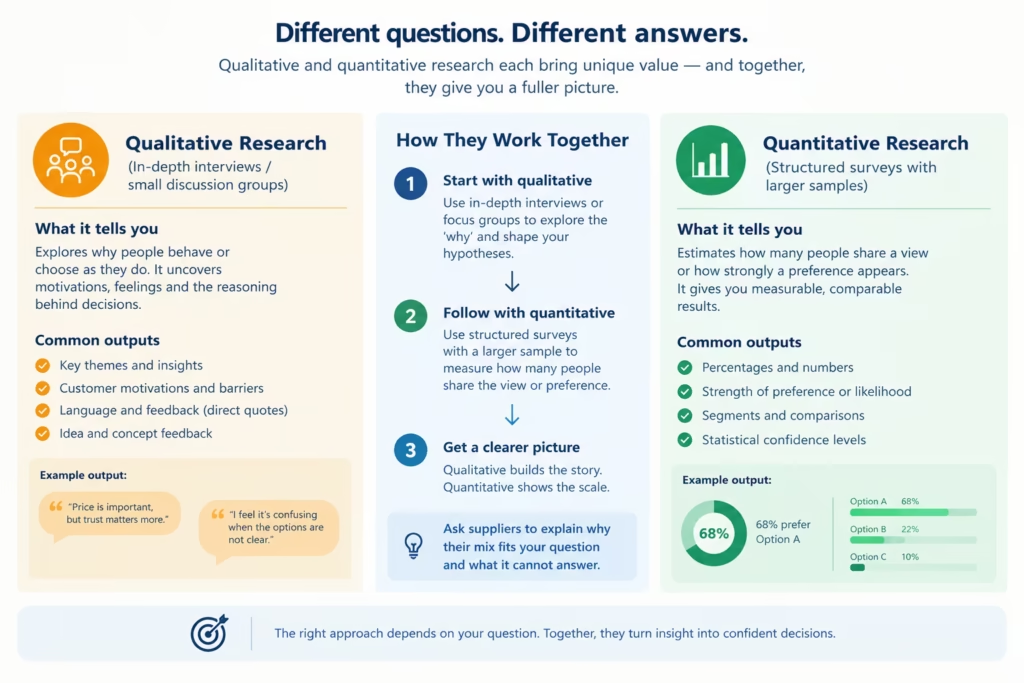
Qualitative methods (in-depth interviews or small discussion groups) explore why people behave or choose as they do. Quantitative methods (structured surveys with larger samples) estimate how many people share a view or how strongly a preference appears.
Many UK projects combine both: qualitative work first to shape hypotheses, then quantitative work to measure prevalence. Ask suppliers to explain why their mix fits your question and what it cannot answer.
Check Relevant Experience and Team Involvement
Look for evidence that the supplier has handled similar audiences, categories or decision types in the UK. Manchester-based or northern UK businesses, for instance, may value suppliers familiar with regional as well as national fieldwork.
Confirm who will design the research, analyse the data and present findings. Senior involvement throughout usually produces clearer recommendations than a model where junior teams deliver after the pitch.
Prioritise Data Quality and Transparent Limitations
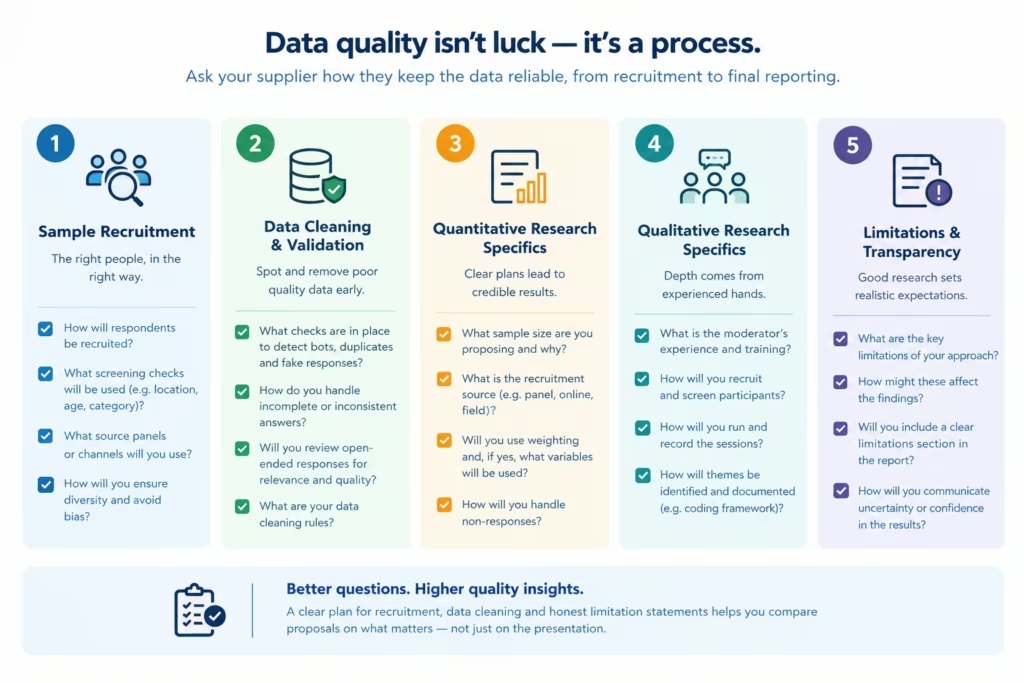
Ask how the supplier recruits respondents, checks data quality and handles incomplete or inconsistent answers. For quantitative work, request the planned sample size, recruitment source and any weighting approach.
For qualitative work, ask about moderator experience and how themes will be documented. Every method has limits; a good proposal states them rather than promising certainty.
Review Ethical and Professional Standards
The Market Research Society (MRS) Code of Conduct sets professional standards for UK research practitioners on participant protection, data handling and reporting. Suppliers that are MRS members or Company Partners are expected to follow it.
Confirm how the supplier will obtain informed consent, protect personal data under UK GDPR and the Data Protection Act 2018, and store or destroy data after the project. This is general information only; seek qualified legal advice for your specific circumstances.
Evaluate the Proposal and Commercial Fit
A clear proposal should cover objectives, method, sample or recruitment plan, timeline, deliverables, limitations and pricing structure. Ask what happens if scope changes and whether analysis time is included.
Compare at least two or three suppliers on the same brief. Look for proposals that link findings to the original decision rather than stopping at descriptive data.
Common Pitfalls to Avoid
- Commissioning research before the decision is clear.
- Choosing solely on lowest price without checking sample quality or analysis depth.
- Accepting results without asking about response rates, bias risks or alternative interpretations.
Market and consumer understanding work often benefits from the same selection criteria used for broader market research services.
When to Involve an External Partner
External market research services are useful when you need independent data collection, specialist analysis skills, or access to audiences you cannot reach internally. They are less suitable when the main need is simply to organise existing internal data.
AMC Insights provides market research services from its published London and Riyadh offices. Availability of specific methods or coverage should be confirmed for each project.
Contact AMC Insights to discuss whether a particular brief fits current capabilities.
About AMC Insights outlines the published UK and Saudi presence.
Conclusion
Selecting market research services is a commercial decision. Start with the business question, match methods to what you need to know, verify data quality and ethical practice, and judge proposals on clarity and relevance. This approach reduces the risk of research that cannot support the decision it was meant to inform.
Frequently Asked Questions
1. What should I look for first when choosing market research services?
Start with a clear statement of the business decision the research must support. Then compare how each supplier’s method, sample plan and analysis will produce evidence usable for that decision.
2. How do qualitative and quantitative approaches differ for UK businesses?
Qualitative research explores reasons and language through smaller samples. Quantitative research estimates how widespread a view or behaviour is. Many projects use both in sequence.
3. Why does the MRS Code of Conduct matter?
It sets professional standards for participant protection, data handling and reporting that MRS members and Company Partners are expected to follow.
4. Can a single research project guarantee commercial success?
No. Research reduces uncertainty around a defined question. Outcomes still depend on how findings are interpreted and applied, market conditions and other factors.