A market entry feasibility study is structured research that tests whether a new geographic area, customer segment or product category is commercially viable before significant investment. It combines secondary evidence on size, growth and rules with primary evidence on demand, competition and barriers so UK teams can decide whether, where and how to enter.
Why a Market Entry Feasibility Study Matters
Entering a new market without evidence increases the chance of mis-sizing the opportunity, underestimating competition or missing regulatory constraints. For UK organisations expanding within Great Britain or into a new vertical, research reduces uncertainty around demand strength, pricing tolerance and channel access.
The study does not guarantee success. It clarifies the conditions under which entry is more or less likely to succeed and highlights the information still needed.
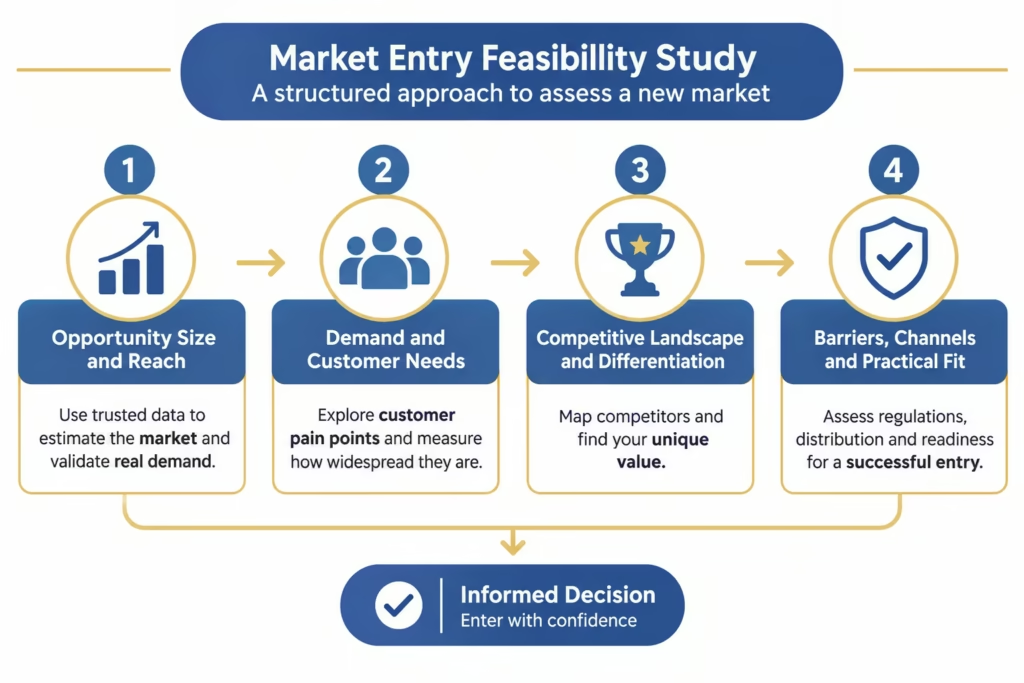
Core Components of Market Entry Research
Opportunity Size and Reach
Start with secondary sources such as Office for National Statistics business data, Department for Business and Trade reports or industry bodies to estimate the addressable market. A market sizing analysis then narrows this to the serviceable portion relevant to the organisation’s offer and geography. Primary validation checks whether stated interest translates into realistic purchase or usage intent.
Demand and Customer Needs
Qualitative interviews or focus groups with potential buyers reveal pain points, current solutions and decision criteria. Quantitative surveys then measure how widespread those needs are and which attributes drive choice. In B2B contexts this often includes mapping the decision-making unit.
Competitive Landscape and Differentiation
Map direct and indirect competitors, their positioning, pricing and perceived strengths. Identify gaps where the organisation’s offer can be distinctive. This stage draws on both desk research and customer feedback on alternatives.
Barriers, Channels and Practical Fit
Examine regulatory requirements, distribution access, cultural or behavioural differences and operational readiness. UK-specific considerations may include regional variations in purchasing behaviour or sector rules. The output is a clear view of what must be true for entry to be practical.
Practical Steps to Conduct the Study
- Define the decision: specify the market, the offer and the commercial threshold that would justify entry.
- Scope secondary research: gather official statistics, trade data and existing reports relevant to the UK context.
- Design primary research: select methods and sample that match the decision (for example interviews with 12–15 decision-makers plus a survey of several hundred potential customers).
- Analyse and synthesise: triangulate findings, note confidence levels and identify remaining uncertainties.
- Present options: outline go, conditional or no-go scenarios with the evidence and risks attached to each.
Hypothetical example: a London-based professional services firm considering expansion into a northern English city might use secondary data on local business density, interviews with potential clients and a short survey on switching drivers. The study would flag whether local relationships or regulatory nuances create material barriers. This illustration is not based on an AMC Insights project.
Limitations and Common Mistakes
Secondary data can be outdated or too broad. Primary samples may not represent the full target. Over-optimism in interpreting stated intent is common. Treating the study as a one-off rather than part of ongoing monitoring also weakens later decisions. Clear research objectives, transparent methods and explicit limitations improve usefulness.
How Findings Inform Decisions
Results typically support choices on whether to enter, which segment to prioritise, how to position the offer and what partnerships or adaptations are required. They also indicate the additional research needed before full commitment. Organisations seeking support can review market research services or B2B research support.
Frequently Asked Questions
What is a market entry feasibility study?
It is research that evaluates the commercial viability of a new market by examining size, demand, competition and practical barriers before major investment.
When should UK businesses commission market entry research?
When the cost of being wrong is high—for example before opening a new location, launching into a different vertical or committing significant marketing spend.
How does market entry research differ from general market research?
It focuses specifically on the decision to enter or not, including barriers and operational fit, rather than ongoing monitoring or brand tracking.
Can secondary research alone support a market entry decision?
It can provide useful context but rarely sufficient evidence on actual demand or competitive response; primary validation is usually needed for higher-stakes decisions.