A competitive landscape assessment maps the full set of alternatives a buyer considers — direct rivals, indirect substitutes and the option of doing nothing — and shows how each is positioned on the dimensions that actually drive choice. For UK teams it reduces the risk of competing on the wrong attributes or underestimating substitutes. The output is not a static list of company names; it is a clear view of structure, gaps and realistic moves.
What a Competitive Landscape Assessment Covers
Unlike a single-competitor deep dive, a landscape assessment looks across the field. It identifies who competes for the same budget or decision, how those options differ in offer, price, channel and perceived strength, and where white space or structural pressure exists.
Typical elements include: the competitive set (direct, indirect and status-quo alternatives), relative positioning on buyer-relevant axes, capability or feature comparison where relevant, and evidence of recent moves such as pricing changes, product launches or channel shifts. Findings support positioning, pricing, product roadmap and market-entry decisions.
Step-by-Step Process
1. Define the arena and the decision
State the buyer, the job-to-be-done and the commercial decision the analysis must inform. A narrow definition (“scheduling tools used by UK field-service teams”) produces sharper results than a broad category label. Without a clear decision, data collection expands without focus.
2. Identify the full competitive set
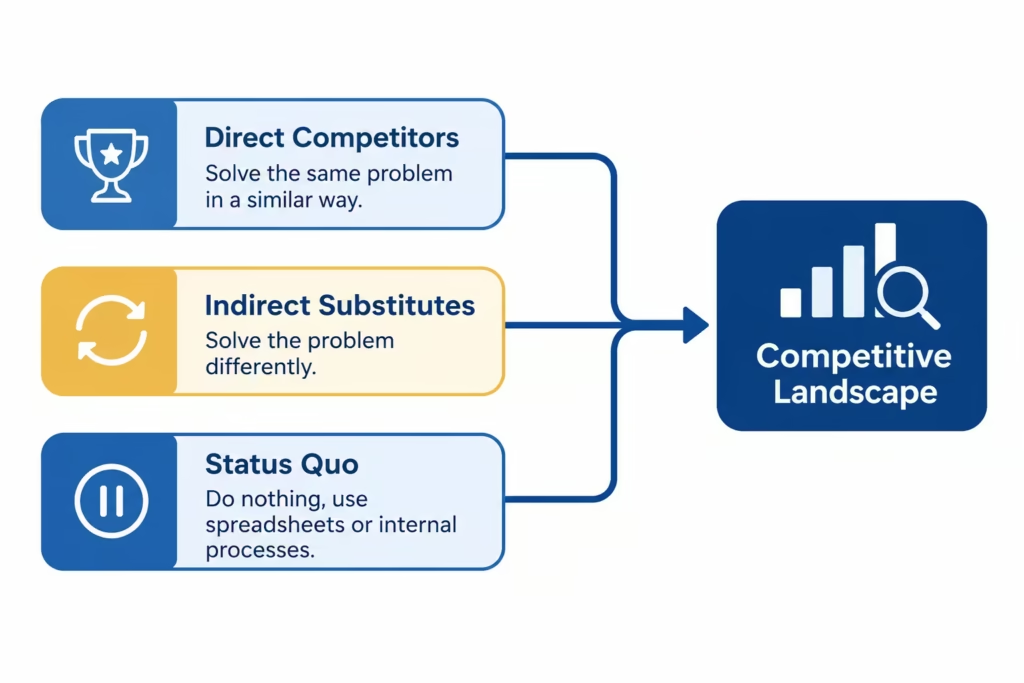
List direct competitors that solve the same problem in a similar way, indirect substitutes that solve it differently, and the status quo (do nothing, spreadsheets, internal processes). Buyer interviews and lost-deal reviews often surface alternatives that internal teams overlook. Cap the working set at a manageable number so evidence stays current.
3. Gather evidence from primary and secondary sources
Use public filings, pricing pages, product documentation, review sites, job postings and news for observable facts. Supplement with primary research: short interviews with recent buyers or lost prospects on why they chose (or rejected) each option, and structured surveys that rate competitors on the attributes that matter. Date every claim. Competitor marketing describes intent; observed behaviour and customer language describe reality.
4. Map on dimensions buyers actually use
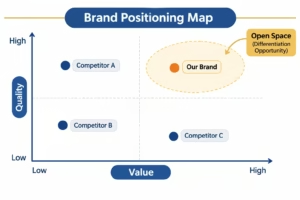
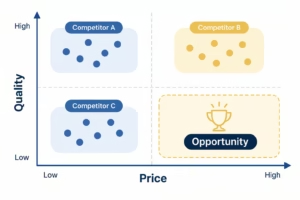
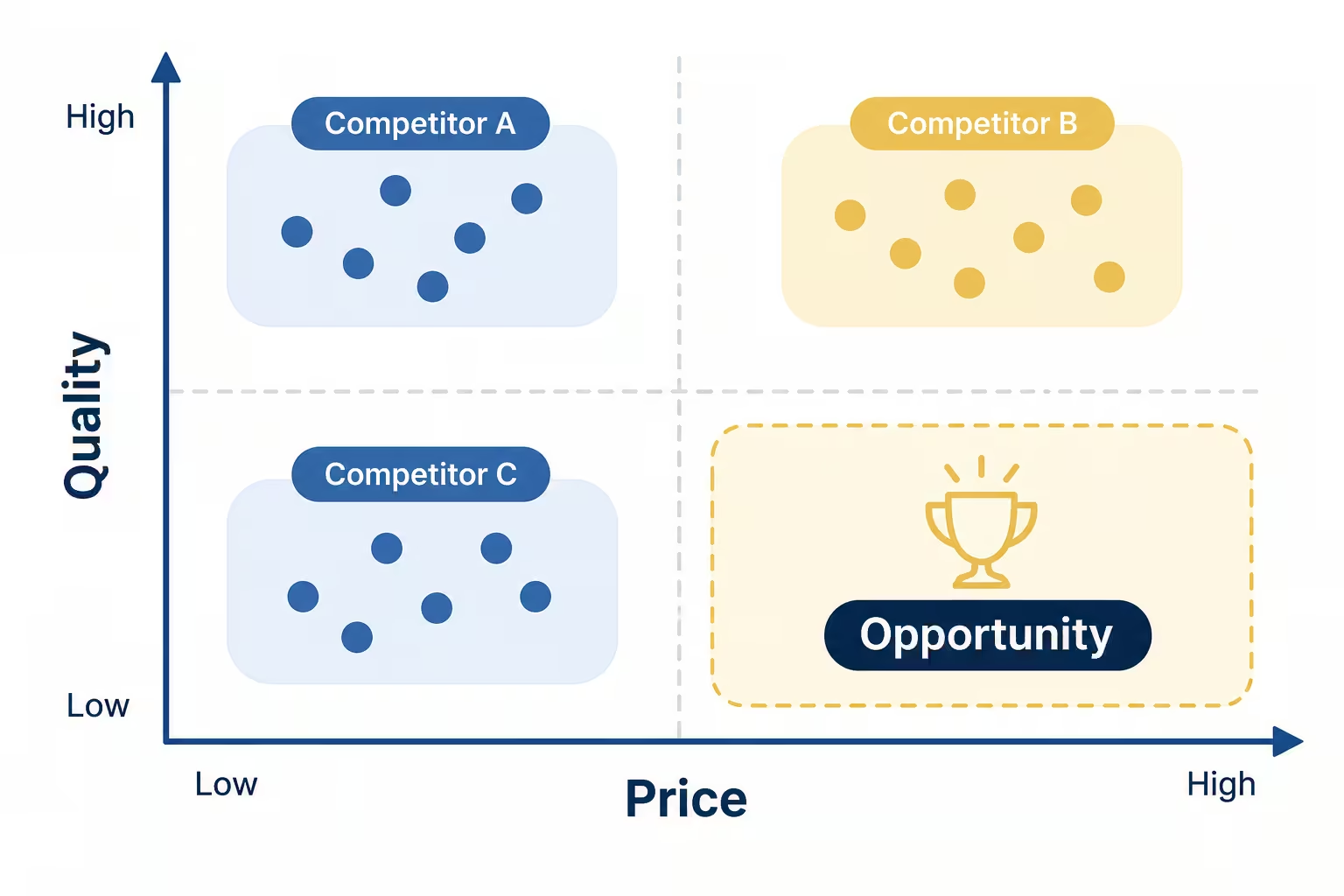
Choose two (sometimes three) axes that reflect real trade-offs — for example coverage versus accuracy, ease of use versus depth, or price versus service intensity. Plot competitors and strategic groups. Empty or lightly occupied space can signal opportunity; crowded space signals pressure. Avoid vanity axes that the brand prefers but buyers ignore.
5. Interpret gaps, risks and implications
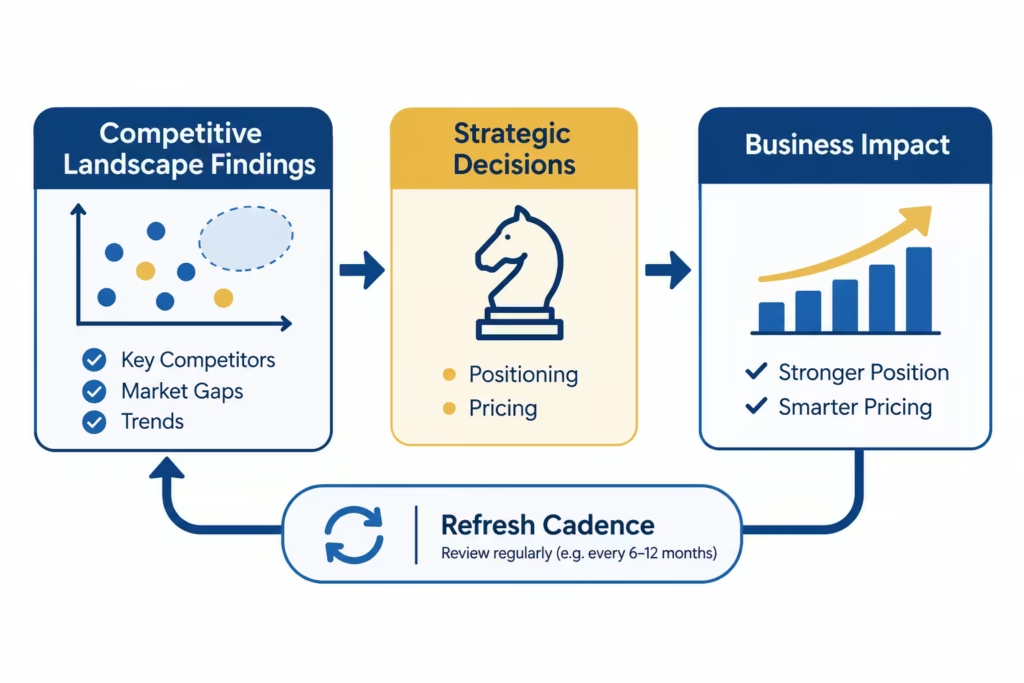
Translate the map into decisions: where differentiation is possible, where parity is required, which competitors deserve deeper monitoring, and what the status quo implies for messaging or proof points. Note confidence levels and remaining unknowns. A landscape that is never refreshed loses value as rivals move.
Frameworks That Support the Analysis
Common tools include a feature or capability matrix, a two-axis positioning or perceptual map, strategic-group clustering, and selective SWOT on the two or three most relevant rivals. Porter’s Five Forces can frame industry structure when the question is about overall attractiveness rather than individual positioning. Use the framework that answers the decision; do not force every study into the same template.
Limitations and Common Mistakes
Stated competitor claims can diverge from actual delivery. Small qualitative samples cannot be generalised. Mapping only on internal preferences produces misleading white space. Treating the analysis as a one-off document rather than a living view leaves teams exposed when the landscape shifts. AI-assisted scanning of public text can accelerate collection but still requires human validation of relevance, bias and accuracy.
Business-to-Business services often incorporate competitive landscape work alongside market sizing and industry intelligence. Broader market research services supply the primary and secondary methods that underpin a robust assessment. Related feasibility questions are covered in market entry research.
Practical Next Steps for UK Teams
- Write the decision and the buyer definition before collecting data.
- Build the competitive set from buyer evidence, not only internal lists.
- Map on attributes that drive choice, then pressure-test with primary input.
- Convert findings into specific actions and a refresh schedule.
- Keep limitations visible when sharing results with stakeholders.
A clear competitive landscape assessment does not guarantee commercial success. It reduces uncertainty about structure, substitutes and relative position so subsequent decisions rest on evidence rather than assumption.
Frequently Asked Questions
What is a competitive landscape assessment?
It is a structured map of the alternatives a defined buyer considers — direct rivals, indirect substitutes and the status quo — showing relative positioning on the dimensions that influence choice.
How does it differ from a single-competitor analysis?
A single-competitor study goes deep on one organisation. A landscape assessment compares the broader set of options so gaps, clusters and structural pressure become visible.
What sources are most reliable?
Observable evidence (pricing, product behaviour, public filings, reviews) and direct buyer feedback outweigh competitor marketing claims. Always date the evidence.
How often should the landscape be updated?
Fast-moving categories may need quarterly review; more stable markets can work with six- or twelve-month cycles. Trigger an update after major competitor moves or a shift in buyer priorities.
Can the analysis be done with secondary data alone?
Secondary sources provide a useful starting map, but primary buyer input is usually required to confirm which alternatives matter and which attributes actually drive decisions.