Brand awareness measurement is the structured process of finding out whether a defined audience knows a brand exists and can recall or recognise it. For UK marketing and insights teams it answers a basic commercial question: does the brand come to mind when a relevant need arises?
Awareness is not the same as preference or consideration. High recognition does not guarantee that people will choose the brand. Measurement therefore needs clear definitions, consistent methods and careful interpretation.
Why brand awareness measurement matters
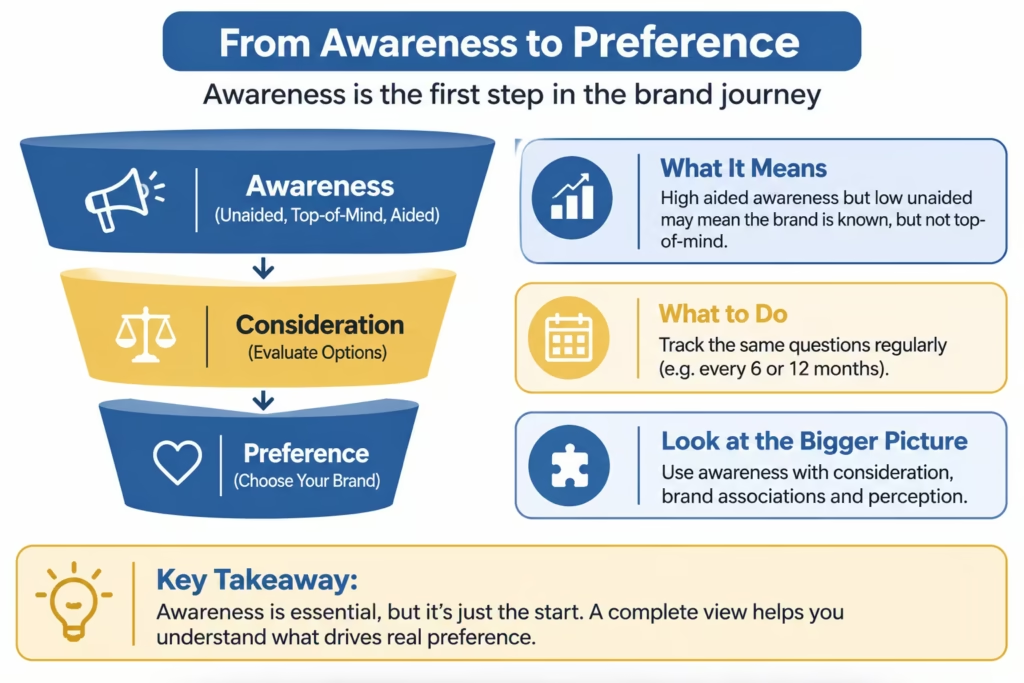
Awareness sits at the top of most brand funnels. Without it, later stages such as consideration, trial and loyalty cannot occur. Tracking awareness over time shows whether communication investment is building mental availability or simply generating short-term noise.
In competitive UK categories, the brands that are named first in unaided recall often enjoy a structural advantage at the moment of choice. Measurement helps teams diagnose whether low performance is an awareness problem or a later-stage problem such as weak preference or poor experience.
The core measures of brand awareness
Three related measures are used most often.
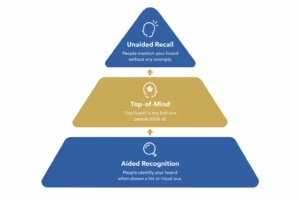
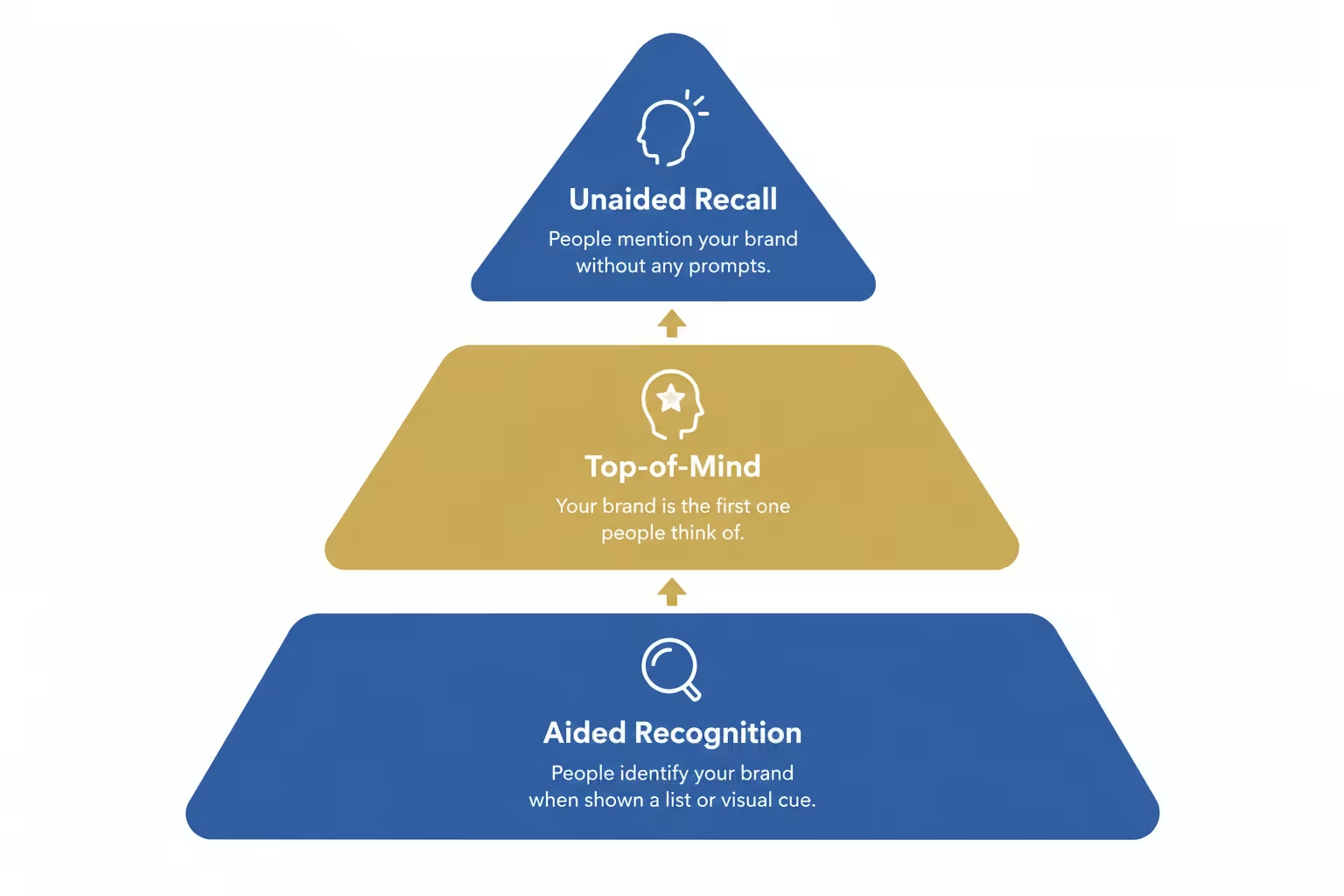
Unaided (spontaneous) awareness asks people to name brands in a category without any prompt. A typical question is: “When you think of [category], which brands come to mind?” The percentage who name the brand is the unaided awareness score.
Top-of-mind awareness is the subset of unaided responses in which the brand is named first. It is the strongest form of awareness because it reflects the brand that surfaces first when a need is triggered.
Aided (prompted) awareness shows a list of brand names or logos and asks which ones the respondent has heard of. The score is almost always higher than unaided awareness because recognition is easier than recall.
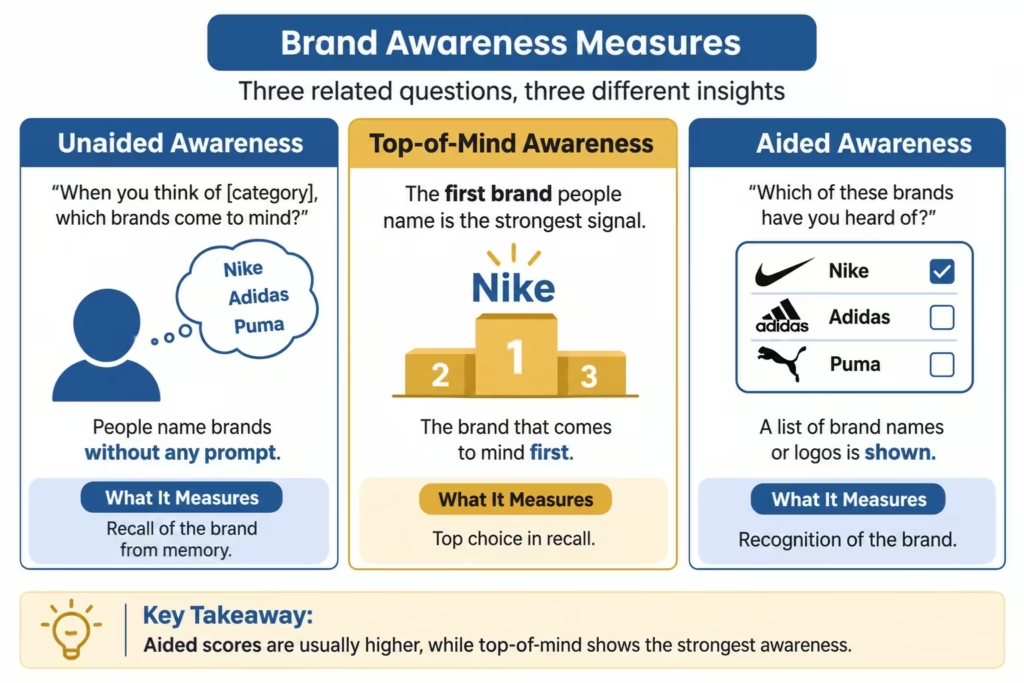
These three measures should be collected in sequence. Unaided questions must come before any brand list is shown, otherwise the list primes memory and inflates the unaided score.
Practical survey methods
Brand tracking surveys remain the most reliable way to measure awareness among a defined target audience. Key design rules include:
- Ask unaided category recall first, with an open box and a “any others?” prompt.
- Extract top-of-mind from the first brand named.
- Only then show a randomised list for aided recognition.
- Keep the competitive set consistent across waves so trends remain comparable.
- Sample the audience that actually buys or influences purchase in the category.
Supporting signals can add context. Branded search volume, direct website traffic and share of voice in media or social conversation act as proxies, but they do not replace survey-based recall and recognition among the target market.
How to interpret and use the scores
Aided awareness that is high while unaided awareness is low often signals that the brand is known but not top-of-mind. Investment may need to focus on distinctive assets, consistent messaging or media that builds mental availability rather than simple reach.
Track the same questions among the same audience definition at regular intervals (for example every six or twelve months). Short-term spikes after a campaign are less useful than sustained movement in unaided and top-of-mind scores.
Always read awareness alongside other brand measures such as consideration, brand associations and brand perception research. Awareness alone does not predict commercial outcomes.
Limitations and common mistakes
Awareness scores are sensitive to sample frame, question wording and category definition. Comparing results across different methodologies or audiences is unreliable. Self-reported recognition can be inflated by social desirability or by respondents who confuse similar brand names.
Treating aided awareness as the main success metric can overstate progress. High aided scores with low unaided scores indicate familiarity without mental availability. Over-surveying the same panel can also create fatigue and bias.
No single awareness number guarantees sales or loyalty. The commercial value of awareness depends on what the brand stands for and how well it performs once chosen.
Hypothetical example
A UK challenger brand in a crowded category (hypothetical) finds 65% aided awareness but only 12% unaided and 4% top-of-mind. The team prioritises distinctive visual assets and consistent category entry points in media rather than further reach investment. This is an illustration only, not an AMC project.
Frequently Questions Asked
What is the difference between unaided and aided brand awareness?
Unaided awareness measures whether people can name the brand without prompting. Aided awareness measures whether they recognise it when shown a list or logo. Unaided is the stronger indicator of mental availability.
How often should brand awareness be measured?
Most organisations track it every six or twelve months among a consistent target audience. More frequent measurement is useful only when major campaigns or market changes need rapid diagnosis.
Is high aided awareness enough?
No. High aided awareness with low unaided or top-of-mind scores usually means the brand is known but not readily recalled when a purchase decision is made.
Can search data replace surveys?
Branded search volume is a useful supporting signal but does not measure awareness among a defined target audience with controlled sampling. Surveys remain the core method for reliable recall and recognition scores.
Conclusion
Brand awareness measurement works best when definitions are clear, unaided questions come first, and scores are read alongside consideration and perception data. Consistent tracking over time gives UK teams evidence of whether investment is building genuine mental availability. Brand and communications services can support the design of awareness tracking and the interpretation of results. For a discussion of your requirements, contact AMC Insights.