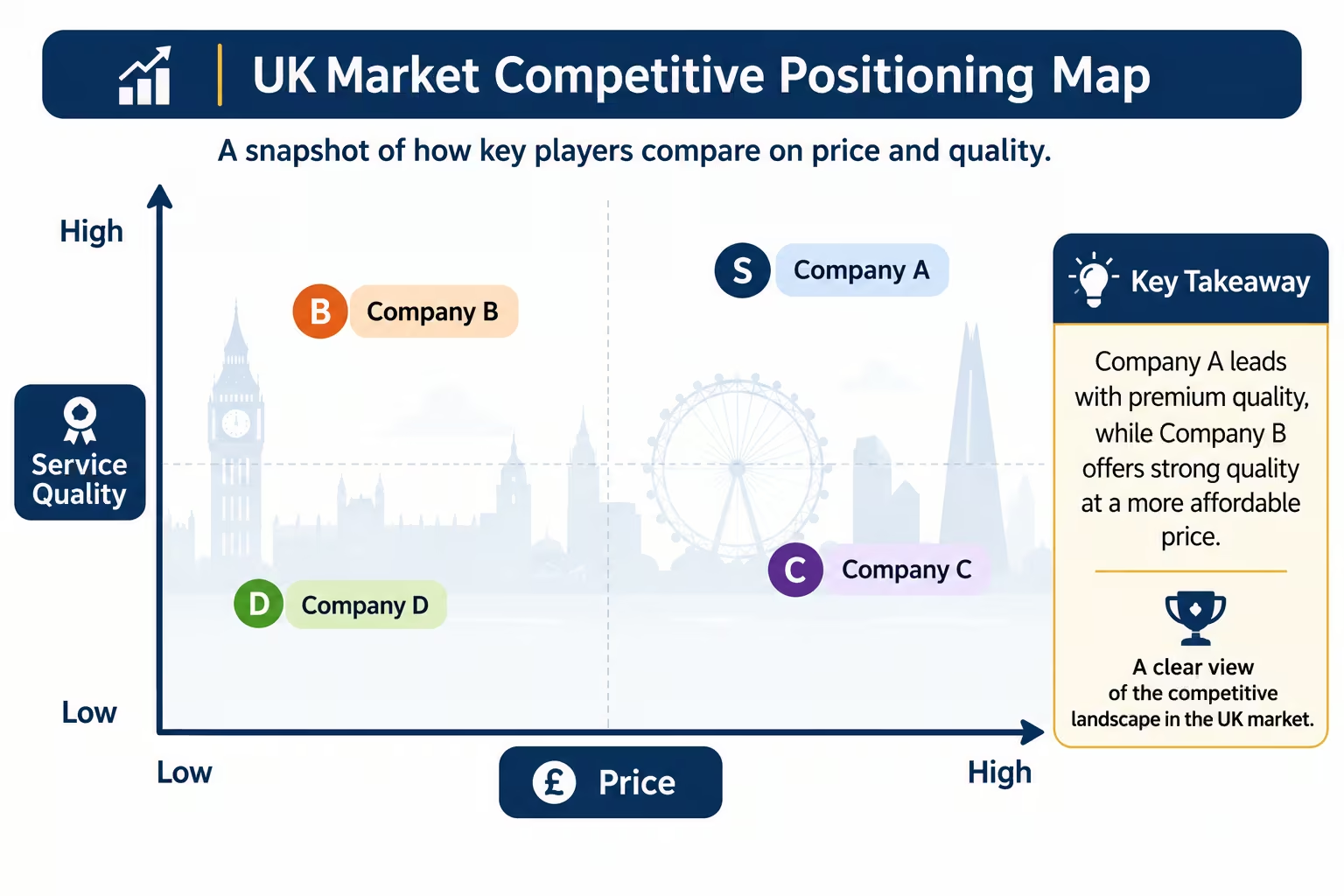
A competitive landscape assessment maps the direct and indirect competitors a UK business actually faces, their strengths, positioning and gaps. It helps teams decide where to compete, what to improve or whether to enter a segment. Secondary public data provides the starting view; primary research with customers or buyers validates what matters in real decisions.
What a competitive landscape assessment covers
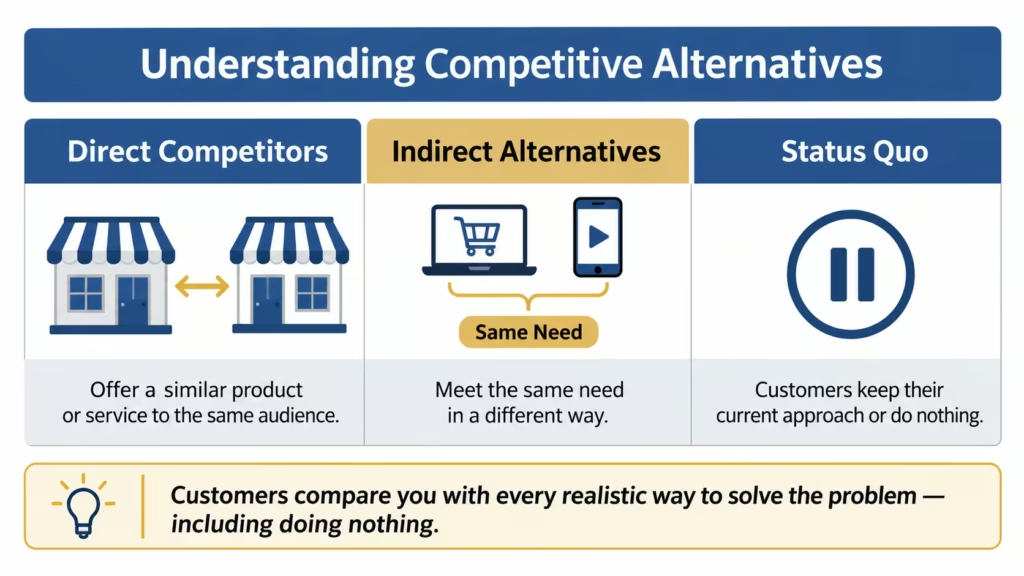
It answers who competes for the same customer problem, how they position, where gaps exist and what evidence supports the view. Direct competitors offer similar solutions to the same buyers. Indirect competitors solve the problem differently (a different product, a service, or doing nothing). The assessment usually includes a short list of 5–8 relevant players rather than an exhaustive industry list.
UK businesses often start with public sources such as Companies House filings for limited companies (accounts, directors, ownership) and ONS business statistics for sector context. These are free and official but lag real-time activity and cover private firms unevenly. Customer or prospect input shows which names actually appear in buying shortlists.
Steps to complete a competitive landscape assessment
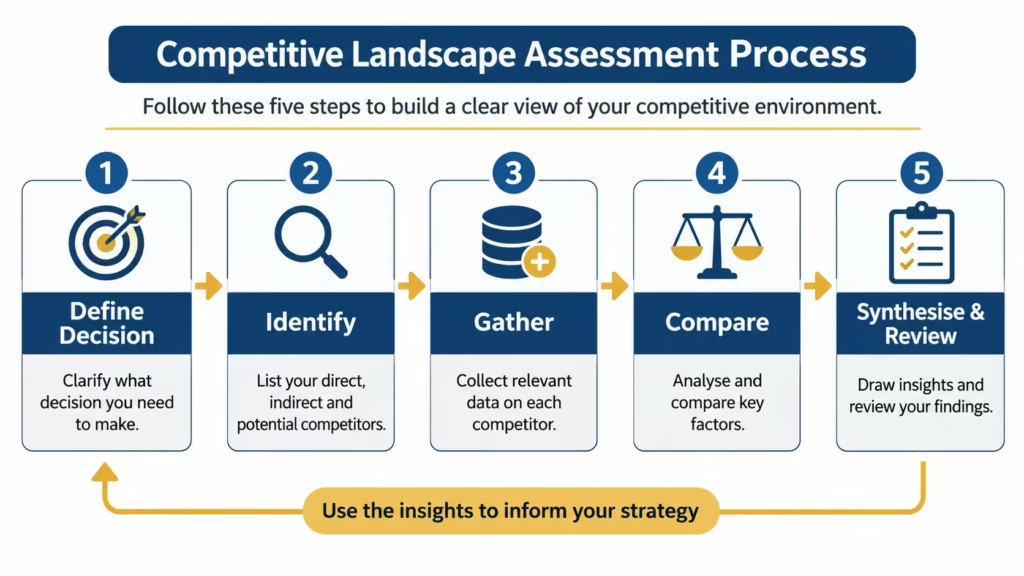
Define the decision first. Examples include repositioning, pricing, new product prioritisation or market entry. Clear scope (geography, segment, time) prevents collecting irrelevant data.
Identify players from sales notes, customer mentions, industry directories and public lists. Separate direct, indirect and aspirational names. Cross-check with buyer language rather than only internal views.
Gather data systematically. Secondary sources include competitor websites, pricing pages, review themes, job postings, press and Companies House records. Primary methods include short surveys asking which alternatives customers considered, interviews with recent buyers or lost deals, and (where feasible) product or service trials. Combine both; secondary data alone can miss perception and switching reasons.
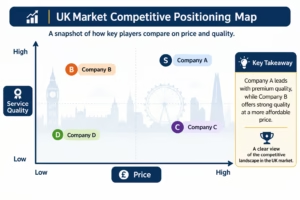
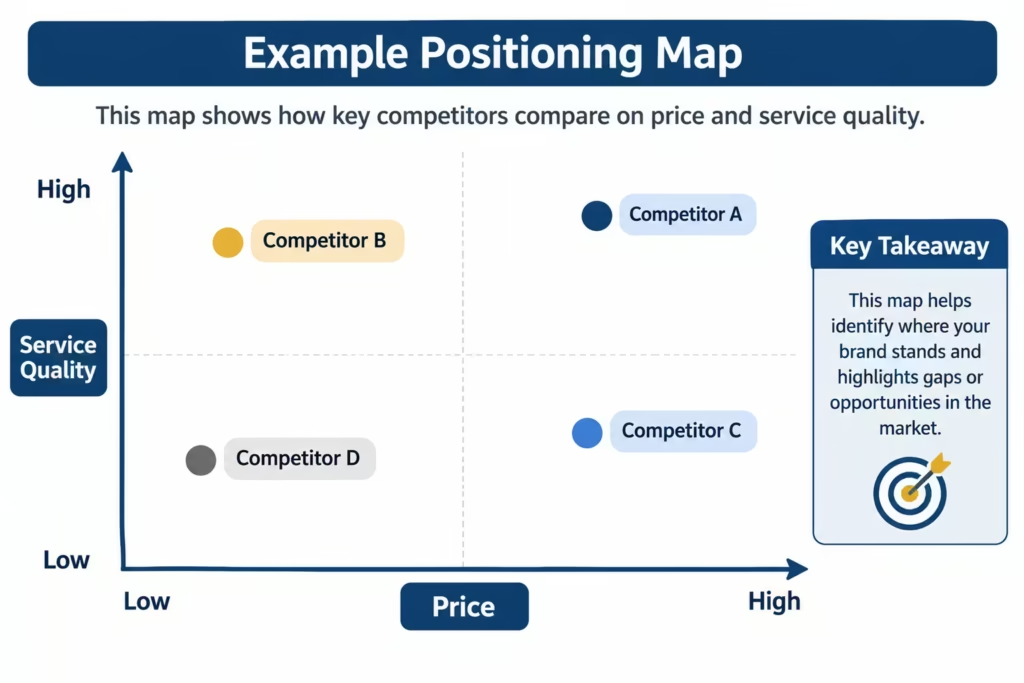
Compare on criteria buyers care about (price, features, reliability, service, delivery). Use a simple matrix or positioning map (for example price versus feature depth). Apply a basic SWOT per major competitor only where it adds clarity. Synthesise into a small number of implications rather than a long data dump.
Update on a schedule. Fast-moving markets need quarterly checks; slower ones may need twice-yearly reviews. Dated sources and stated limitations keep the output usable.
Methods, data quality and limitations
Secondary research is faster and lower cost but can be incomplete, outdated or promotional. Primary research reduces that risk yet requires representative sampling and careful question design to avoid leading responses. In the UK, Companies House provides transparent corporate data for limited companies, but sole traders and some private firms leave thinner trails. Sector statistics from the ONS or industry bodies give context without naming individual competitors.
Common mistakes include listing only obvious rivals, scoring on easy-to-measure features instead of buyer priorities, treating one snapshot as permanent, or generalising from small non-representative samples. Correlation between activity (for example more job postings) and strategy is not causation. Findings inform decisions; they do not guarantee outcomes such as share gains or revenue.
For B2B or regulated markets, expert interviews or panel data may be needed alongside public sources. Always record source, date and geography so later readers can judge freshness.
How findings inform decisions
A clear map can highlight underserved segments, pricing gaps, messaging differences or capability shortfalls. It supports choices on differentiation, resource allocation or whether further research (concept testing, sizing) is warranted. Link the output to the original decision so teams know what action it enables and what it cannot answer.
Practical considerations for UK organisations
Start small: one segment, five competitors, mixed secondary and light primary. Involve sales or customer-facing teams early so the list reflects real encounters. Document assumptions and data gaps explicitly. For multi-site or national work, check whether London patterns differ from Manchester, Birmingham or other regions rather than assuming uniformity.
AMC Insights provides market research services and business-to-business research and intelligence services that can support structured competitive landscape work when internal capacity or specialist methods are required. Offices are published in London and Riyadh only.
Frequently Asked Questions
What is the difference between competitive landscape assessment and competitor analysis?
Competitive landscape assessment covers the broader set of direct, indirect and status-quo alternatives plus market context. Competitor analysis often focuses more narrowly on named rivals’ strengths and weaknesses.
Which UK public sources are useful?
Companies House filings for limited companies and ONS business statistics provide official starting points. They should be supplemented with customer input and dated carefully because of lags and coverage limits.
How often should a competitive landscape assessment be updated?
Quarterly in fast-moving sectors and at least twice yearly in slower ones. One-time reports lose relevance as competitors and buyer criteria change.
Can this replace primary customer research?
No. Secondary data maps what is public; primary research shows what buyers actually consider and value. The strongest assessments combine both.