
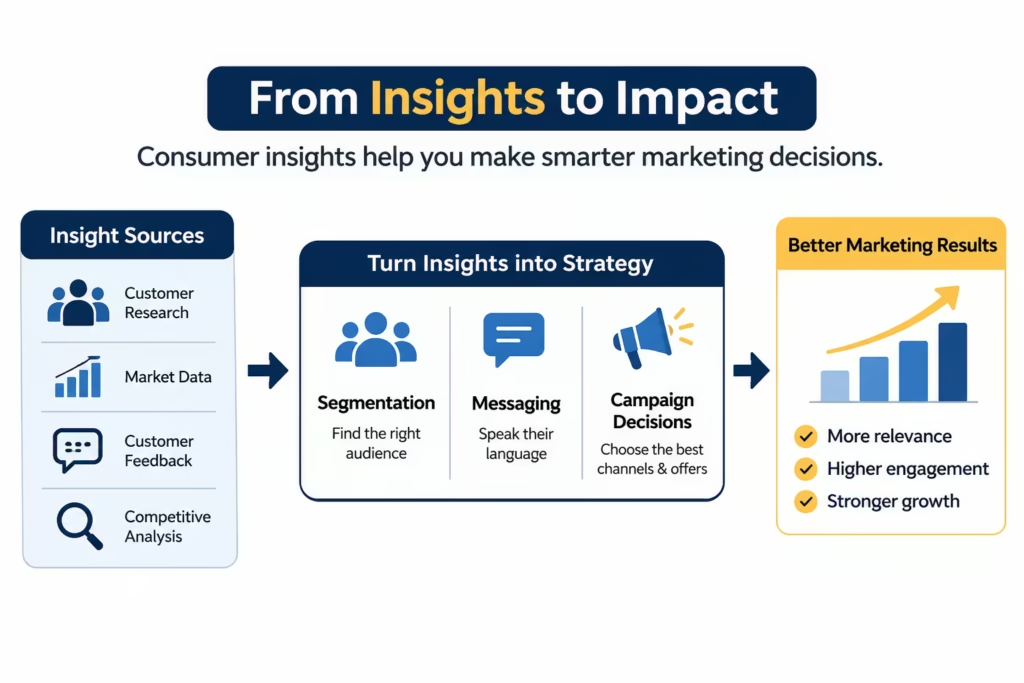
Consumer insights in marketing are evidence-based understandings of why people notice, choose, use or reject products and brands. They help UK marketing teams move beyond assumptions when deciding on segments, messages, channels and offers. This guide explains how to apply them, what decisions they support, and the limitations that keep findings useful rather than misleading.
What consumer insights are and how they differ from raw data
Consumer insights combine what people say, what they do and the context around those behaviours. Raw data such as survey scores or sales figures describe what happened. Insights explain why it happened and what that implies for a specific marketing decision. For example, knowing that 40 percent of a target group switched brands is data; understanding that the switch was driven by a perceived gap in convenience is an insight that can shape messaging.
Insights draw on primary research (surveys, interviews, focus groups) and secondary sources (official statistics, industry reports). In the UK, bodies such as the Food Standards Agency publish regular consumer insights trackers that monitor attitudes and behaviours on specific topics. These provide a model of transparent method, sample and limitations. Professional standards from organisations such as the Market Research Society emphasise data quality, transparency and ethical use of findings.
Turning insights into segmentation and messaging decisions
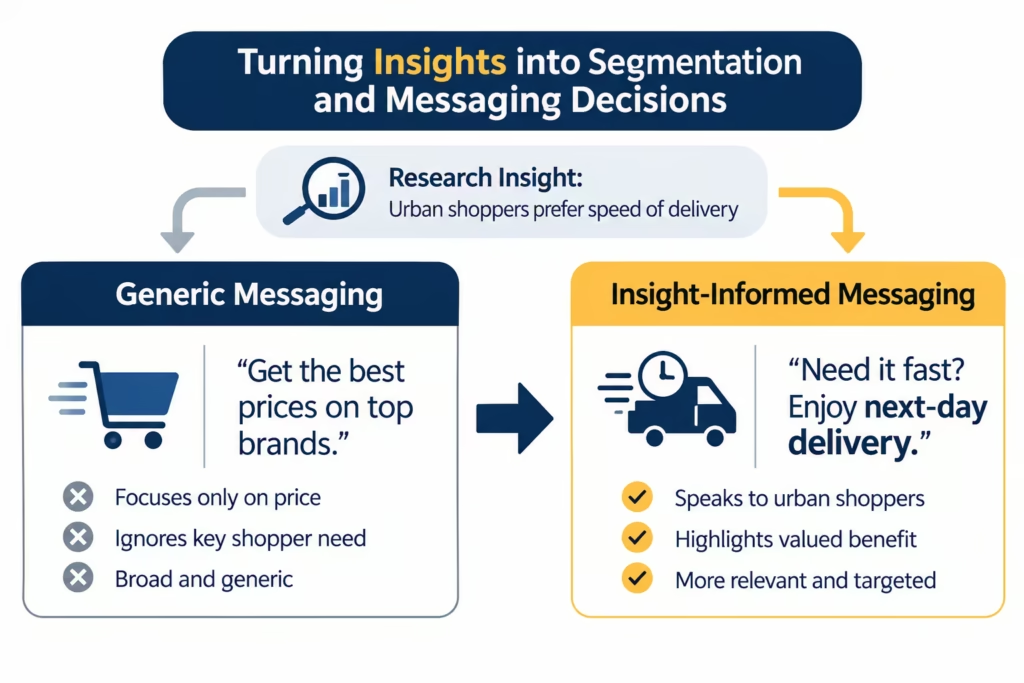
Once insights are clear, marketing teams can refine segments beyond basic demographics. Behavioural and attitudinal segments often prove more useful for campaign decisions. A hypothetical UK retailer, for example, might find that a group of urban shoppers prioritises speed of delivery over price for certain categories. This insight supports a targeted message and channel choice rather than a broad price-led campaign.
Messaging benefits when it uses language close to that of the audience. Insights from open-ended responses or interviews reveal the words people actually use to describe a problem or benefit. Teams can test whether proposed copy reflects those words before wider rollout. Limitations apply: small qualitative samples reveal themes but do not quantify prevalence. Larger quantitative work is usually needed to confirm how widely a theme applies.
Applying insights to channels, offers and campaign evaluation
Insights also inform channel selection and offer design. If research shows a segment researches products on mobile during commuting hours, that supports mobile-optimised content and timing rather than desktop-only creative. Offer testing can check whether a proposed incentive matches the barrier identified in the insight. Post-campaign evaluation then checks whether the expected response occurred, feeding the next round of insight work.
Common mistakes include treating a single study as permanent truth, ignoring sample limitations, or assuming correlation equals causation. UK marketers should also consider data protection requirements under UK GDPR when using personal data for insight work. Official guidance from the Information Commissioner’s Office sets out expectations for lawful, fair and transparent processing; legal advice is needed for specific situations.
Practical steps for UK marketing teams
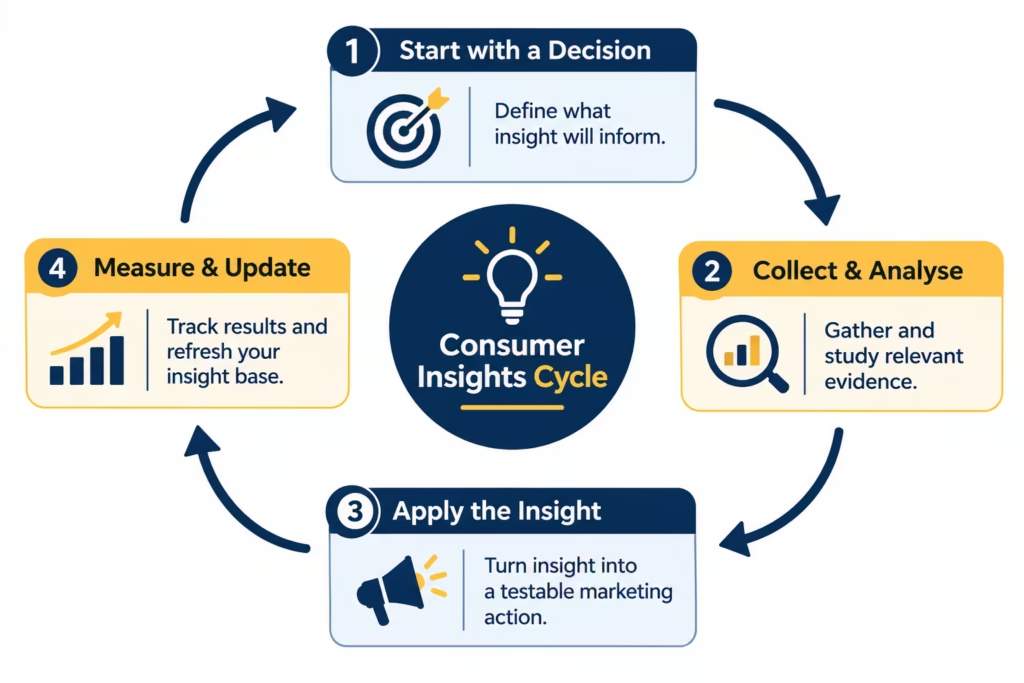
Start with a clear decision the insight must inform. Collect or commission evidence that matches the decision, using appropriate methods and transparent sampling. Analyse findings with stated limitations. Translate only the relevant insight into a testable marketing action. Measure the result and update the insight base. This cycle keeps work practical and reduces the risk of over-interpreting limited data.
Limitations and when further research is needed
Insights are only as good as the evidence and context behind them. Non-representative samples, outdated data or poorly designed questions can produce misleading directions. Insights from one category or geography do not automatically transfer. When a decision involves significant investment, teams usually need confirmatory research rather than relying on a single exploratory study. AI tools can help process large volumes of text, but they require human oversight for bias, accuracy and business context.
Market and consumer understanding services can support organisations that need structured insight work linked to specific marketing decisions. Related insights consultancy may help translate findings into strategy. For guidance on gathering the underlying evidence, see how to conduct consumer behaviour research.
Frequently Asked Questions
What is the difference between consumer insights and consumer data?
Consumer data describes observations or measurements. Consumer insights interpret those observations to explain behaviour and inform a specific marketing decision, with stated limitations.
How often should marketing teams update consumer insights?
Frequency depends on the market and decision. Stable categories may need less frequent updates than fast-moving ones. Material changes in behaviour, competition or regulation usually justify new evidence.
Can small qualitative studies support major campaign decisions?
They can reveal useful themes and language, but they do not measure how widespread those themes are. Major investment decisions usually require confirmatory quantitative work or multiple evidence sources.
Do consumer insights guarantee better campaign results?
No. Insights reduce uncertainty when used carefully, but external factors, execution quality and market conditions also affect outcomes. They inform decisions rather than guarantee results.