
customers, competitors, markets and context so organisations can make better-informed decisions. It typically combines secondary sources such as official statistics with primary methods such as surveys or interviews, adapted to local language, culture and regulation.
A clear business question should drive the work. Common uses include assessing market entry feasibility, testing product concepts, understanding consumer behaviour, sizing opportunity or monitoring brand health. Findings are directional rather than guaranteed outcomes; sample quality, question design and local context all affect reliability.
Why Market Research Matters in the Saudi Context
Saudi Arabia’s economy continues to diversify under Vision 2030. Official statistics from the General Authority for Statistics (GASTAT) provide a reliable starting point for secondary research on population, economic activity, prices and digital usage. These data help frame questions before any primary fieldwork begins.
Primary research then tests specific hypotheses with the relevant audience. Local cultural considerations, Arabic-language materials and appropriate recruitment channels improve response quality. Research that ignores these factors risks weak or misleading results.
Step-by-Step Process for Conducting Research
1. Define the decision and objectives
Start with the business decision the research must inform. Write specific, measurable objectives. For example, “estimate awareness and purchase intent for a new category among urban professionals in Riyadh and Jeddah” is clearer than “learn about the market.”
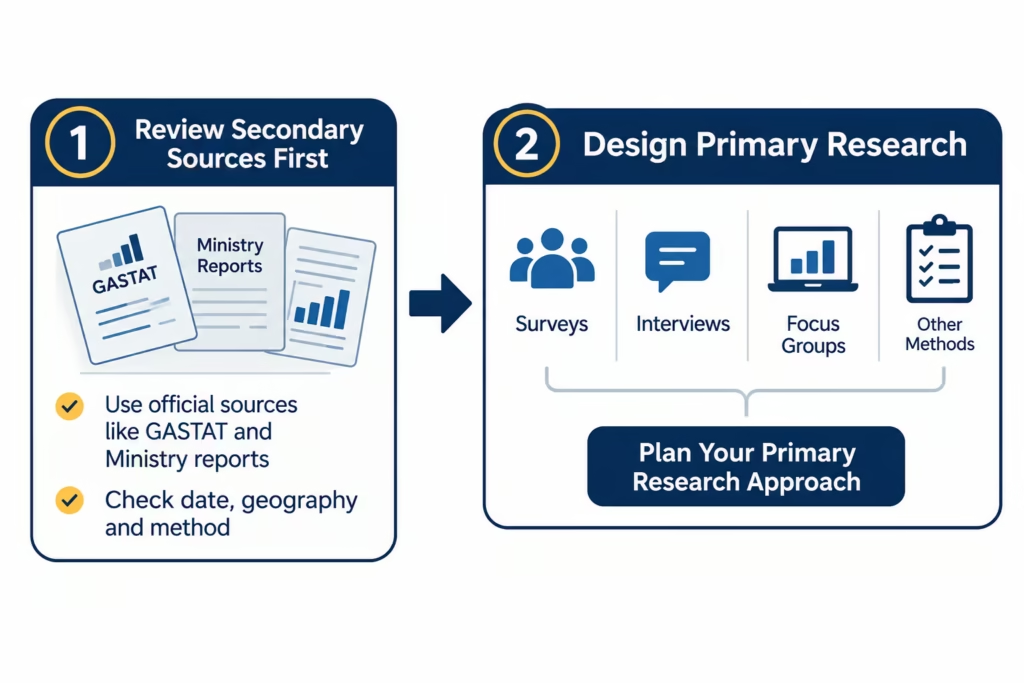
2. Review secondary sources first
Use GASTAT publications, Ministry reports and other official or industry body data for context. This is usually faster and lower cost than primary work. Note the date, geography and method of each source so limitations are transparent.
3. Choose methods and sample
Qualitative methods (in-depth interviews, focus groups) explore motivations and language. Quantitative methods (structured surveys) measure prevalence. Mixed approaches are common. Sample design must match the target population; convenience samples have clear limitations.
4. Design instruments and recruit
Questions should be neutral, pre-tested and available in appropriate language. Recruitment should aim for the defined audience. Incentives and channels need to be ethical and practical.
5. Collect, analyse and report
Clean data, code open responses and look for patterns. Report findings with method, sample details, key results and limitations. Separate observation from interpretation. Recommendations should link back to the original decision.
Key Local Considerations
Data protection is governed by the Personal Data Protection Law (PDPL) administered by the Saudi Data and AI Authority (SDAIA). Research involving personal data requires a lawful basis, transparency and appropriate safeguards. Cross-border transfer rules may apply. Organisations should seek qualified legal advice rather than treat research guidance as compliance advice.
Cultural and linguistic fit also matters. Arabic-language materials, gender-appropriate recruitment where relevant, and awareness of regional differences within the Kingdom improve participation and insight quality.
Common Limitations and Mistakes
Secondary data may be dated or not specific enough for the commercial question. Primary samples that are too small or unrepresentative cannot support broad claims. Leading questions, poor translation or ignoring non-response bias weaken findings. Treating any single study as definitive is another frequent error.
How Findings Support Business Decisions
Well-designed research helps prioritise opportunities, refine propositions, identify competitive gaps or improve customer experience. It reduces uncertainty but does not eliminate it. Decision-makers still apply commercial judgement, test in market where possible and monitor results.
Organisations seeking support with design, fieldwork or analysis can explore market research services or insights consultancy. AMC Insights has published offices in London and Riyadh and offers research relevant to both UK and KSA contexts.
Contact AMC Insights to discuss a specific research need.
Frequently Asked Questions
What is the first step in market research in Saudi Arabia?
Define the business decision and specific objectives before choosing methods or collecting data.
Where can I find reliable secondary data on Saudi Arabia?
The General Authority for Statistics (GASTAT) publishes official statistics covering economic, demographic and other indicators.
Do I need to follow data protection rules for research?
Yes. The Personal Data Protection Law applies to personal data processing involving individuals in the Kingdom. Qualified legal review is recommended.
How long does a typical primary research project take?
Timelines vary with scope, method and audience. Many studies range from several weeks to a few months; a scoped proposal provides a clearer estimate.
Conclusion
Conducting market research in Saudi Arabia follows the same core principles as elsewhere—clear objectives, appropriate methods, transparent limitations—while requiring attention to local sources, language, culture and regulation. Starting with official secondary data and designing primary work carefully produces more useful evidence for decisions.