
Business insights and analytics turn raw organisational and market data into evidence that reduces uncertainty in decisions. An analytics consultancy helps UK teams move from intuition alone to structured interpretation of patterns, risks and opportunities, while recognising that analytics never replace judgement or context.

What Business Insights and Analytics Mean for Decision-Makers
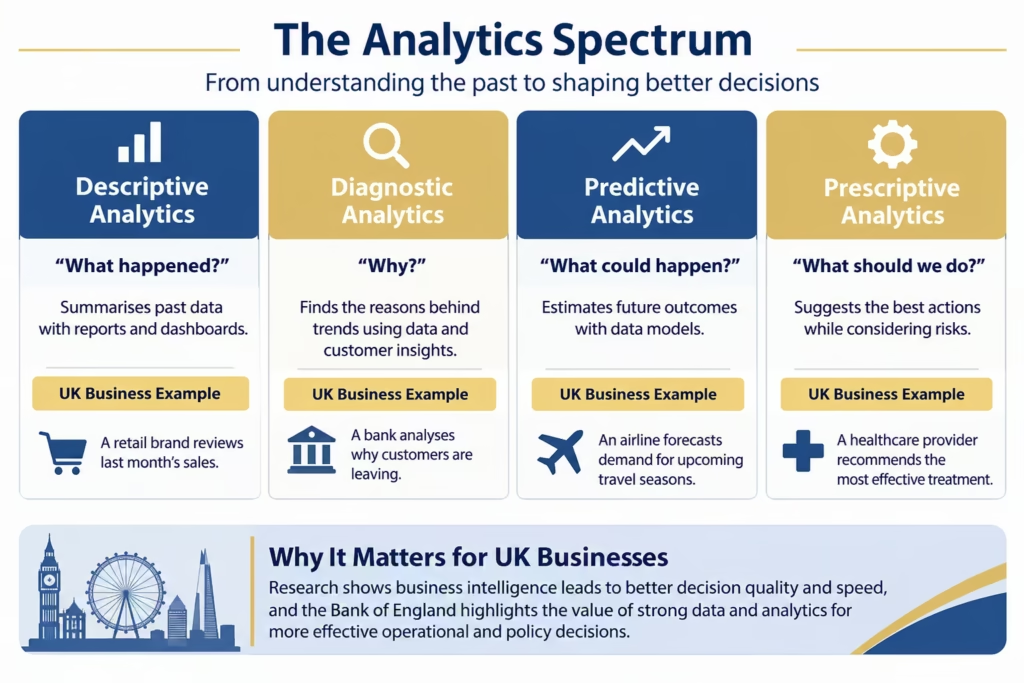
Business insights are the interpreted findings drawn from data that explain why something is happening or what might happen next. Analytics covers the methods used to produce those findings: descriptive summaries of past performance, diagnostic investigation of causes, predictive modelling of likely outcomes and, in some cases, prescriptive recommendations.
In UK organisations these typically combine internal sources (sales, CRM, operational systems) with external market data. The goal is not more dashboards; it is clearer options for a specific decision, such as pricing, resource allocation or market entry. Research on strategy processes notes that analytics remains an emerging capability rather than a fully structured organisational practice (Kunc & O’Brien, 2018).
How Analytics Supports Different Types of Decisions
Descriptive analytics answers “what happened?” and is the foundation for most management reporting. Diagnostic work asks “why?” by combining quantitative patterns with qualitative context from customers or staff. Predictive models estimate probabilities under stated assumptions. Prescriptive approaches suggest actions but still require human review of feasibility, ethics and risk.
A literature synthesis shows business intelligence is consistently linked to improved decision quality and speed, yet effects on overall performance are usually indirect and mediated by analytical capability and culture (various systematic reviews). Bank of England strategy documents emphasise that better data and analytics support more effective operational, policy and management decisions when access, skills and governance are in place.
Practical Steps for UK Organisations
Start with the decision, not the tool. Define the question, the stakeholders, the acceptable level of uncertainty and the data that would change the choice. Clean and integrate relevant datasets; poor data quality is a recurring barrier in UK SME studies. Apply the lightest method that answers the question. Validate outputs against known reality or hold-out data. Present findings with explicit assumptions, confidence ranges and limitations.
Insights consultancy services can help assess existing data infrastructure, design the approach and turn outputs into recommendations that fit the organisation’s context. Where customer-generated text or reviews are involved, digital and technology services may support AI-assisted text analytics under human oversight.
Benefits, Limitations and Risks
Potential benefits include faster identification of patterns, reduced reliance on incomplete anecdotes, better prioritisation of limited resources and clearer communication of trade-offs. UK SME research highlights gains in productivity, demand forecasting and customer retention when data science is applied appropriately, while also recording low adoption rates and resource constraints.
Limitations are material. Historical data do not automatically predict the future. Numbers omit qualitative factors such as staff motivation or brand perception. Models can amplify bias present in the training data. Over-reliance on self-service tools without governance raises privacy and security risks under UK GDPR. Analytics should therefore be one input among others, not a substitute for domain expertise or regulatory compliance.
Common Mistakes and How to Avoid Them
Teams often collect data without a clear decision use-case, treat correlation as causation, or present precise-looking forecasts without stated assumptions. Another frequent error is investing in platforms before fixing data quality or skills. Human oversight remains essential: AI-generated insights must be checked for relevance, bias and completeness before they influence strategy.
For organisations that lack in-house capacity, an external market research services partner can supply primary evidence that analytics alone cannot generate.
Next Steps
Clarify the decision that needs better evidence, inventory the data you already hold, and identify gaps that primary research or external analysis could fill. Then decide whether internal capability, external analytics consultancy, or a combination is the most efficient route.
Contact AMC Insights to discuss whether insights consultancy or related research support would help your specific UK decision.
Frequently Asked Questions
What is the difference between business insights and raw analytics outputs?
Insights are the interpreted conclusions and implications that answer a business question. Raw analytics outputs are the tables, charts or model scores before that interpretation and contextualisation occur.
When should a UK company use an external analytics consultancy?
When the decision is high-stakes, internal skills or data infrastructure are limited, an independent view is needed, or specialised methods (for example text analytics of customer feedback) are required. The consultancy should still work to the organisation’s stated decision criteria.
Do analytics guarantee better outcomes?
No. They improve the quality of evidence available. Outcomes also depend on implementation, market conditions, competitor actions and execution quality. Limitations of the data and method must be stated.
How does UK data protection law affect analytics projects?
Personal data processing must comply with UK GDPR and the Data Protection Act. Organisations should document lawful basis, minimise data, apply appropriate security and, where AI is used, review outputs for bias. Legal advice should be sought for specific cases.