
Voice of customer research (VoC) is the structured collection and analysis of what customers say about their experiences, needs and expectations. It draws on surveys, interviews, reviews, support interactions and behavioural signals so organisations can improve products, journeys and service. In the UK it sits within customer experience work and must respect data-protection requirements.
What voice of customer research involves
VoC programmes capture customer language and evidence across multiple sources. Typical inputs include relationship and transactional surveys, open-text comments, interviews, focus groups, review sites, social listening, complaint records and contact-centre interactions. The goal is not simply to score satisfaction but to understand the reasons behind those scores and the actions that would improve outcomes.
The Institute of Customer Service’s UK Customer Satisfaction Index (UKCSI) provides a national benchmark of customer satisfaction across sectors. Organisations often use their own VoC data alongside such external measures to see relative performance and prioritise internal improvements.
Why VoC matters for UK organisations
Customers leave evidence of their experience in many places. Without a systematic way to collect and interpret that evidence, teams rely on anecdote or incomplete metrics. VoC research helps identify friction points, unmet needs and strengths that can be protected or amplified. It supports prioritisation of product fixes, service recovery, messaging and process changes.
Findings are most useful when linked to a clear decision: which journey stage to redesign, which product attribute to improve, or which segment needs different treatment. VoC does not replace strategic judgment; it reduces the risk of acting on assumptions.
Common methods for collecting the customer voice
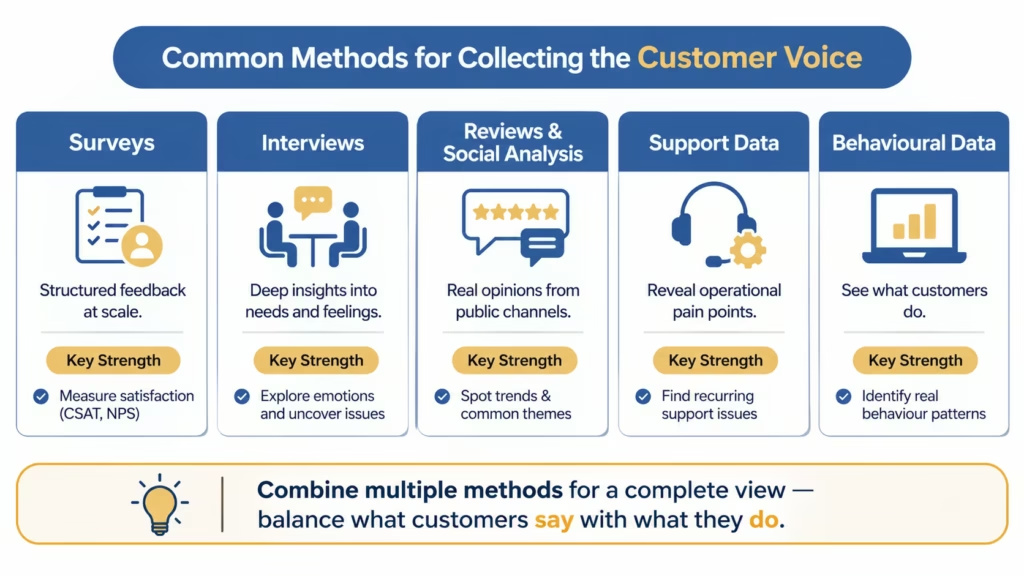
No single method covers every need. Surveys (including CSAT, NPS and customer-effort questions) provide structured measurement at scale. In-depth interviews and moderated discussions surface language, emotions and unexpected issues. Review and social analysis capture unsolicited opinions. Support tickets and call transcripts reveal operational pain. Behavioural data (website journeys, app usage) shows what people actually do.
Strong programmes combine methods so stated feedback can be checked against observed behaviour. Qualitative depth helps interpret quantitative scores; quantitative data shows how widespread a theme is. Limitations include response bias, the gap between stated and actual behaviour, and the difficulty of reaching non-customers or silent customers.
Customer Experience services can design multi-method VoC approaches matched to specific commercial questions.
Turning feedback into insight and action
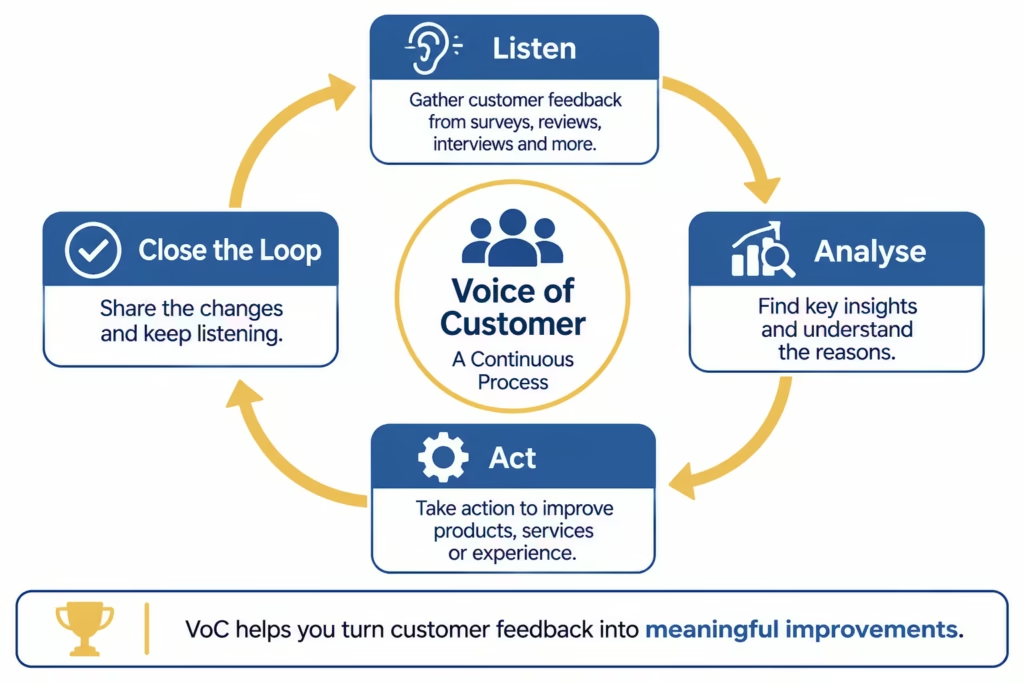
Raw feedback has limited value until it is coded, themed and linked to business impact. Analysis typically involves grouping open-text comments, identifying recurring drivers of satisfaction or dissatisfaction, segmenting by journey stage or customer type, and quantifying the prevalence of key themes. Human review remains essential when automated text analysis is used, especially for context, sarcasm or sensitive content.
The final and often weakest step is closing the loop: assigning ownership, implementing changes, and, where appropriate, telling customers what has changed. Without this step, VoC becomes a reporting exercise rather than a decision tool.
Data protection and ethical points in the UK
Customer feedback often contains personal data. Under UK GDPR and the Data Protection Act 2018, organisations must identify a lawful basis for processing, be transparent about purpose, minimise data collected, and support data-subject rights. Consent is not always required; legitimate interests may apply in some operational feedback contexts, provided the processing is fair and proportionate. Open-text comments and recordings can reveal sensitive information and need careful handling. Organisations should document purpose, retention and access rules and seek qualified advice for their specific arrangements rather than relying on general guidance.
Practical starting points
Begin with a decision the research must inform. Map existing feedback sources before adding new ones. Choose a manageable set of metrics and qualitative channels rather than collecting everything. Pilot instruments, train teams on consistent coding, and define how findings will be reviewed and acted on. Report limitations clearly so decision-makers can weigh the evidence.
Market and Consumer Understanding support can help connect VoC findings with broader customer and market insight. For scoped projects, contact AMC Insights to discuss requirements.
Frequently asked questions
What is the difference between voice of customer research and a customer satisfaction survey?
A satisfaction survey is one common VoC method that produces structured scores. Voice of customer research is broader: it includes surveys plus interviews, reviews, support data and behavioural signals, with the aim of understanding reasons and driving action.
How often should a VoC programme run?
It depends on the decision cycle. Transactional feedback can be continuous; relationship surveys are often quarterly or twice-yearly; deeper qualitative work is usually project-based. The key is regular enough to support decisions without overwhelming teams.
Can VoC data be used without customer consent under UK GDPR?
Consent is one lawful basis but not the only one. Legitimate interests or other bases may apply for certain operational feedback, provided processing is transparent, necessary and fair. Identifiable data still requires appropriate safeguards. Seek specific legal advice for your use case.
What is “closing the loop” in VoC?
It means acting on findings and, where relevant, informing customers or internal teams of the changes made. Without this step, feedback collection has limited impact on experience or trust.